















Step-by-step Transformation Guide for Professional Services Firms
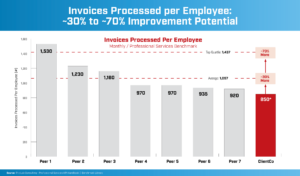
Increase organizational capacity 26% to 41%
The Transformation Imperative
Why Professional Services Firms Must Evolve
As a professional services firm executive (or business unit lead or part of an internal improvement team), you likely already understand that strategic transformation begins with process-mapping your as-is state. This includes all end-to-end activities and client journeys, mapped down to the detail of a single unit of effort spanning about one to three minutes apiece. (Mapping for automation requires more focused detail… down to the keystroke level.)
End-to-end or E2E process mapping of your as-is state is the first step on the road toward strategic transformation in professional services. The transformation itself can include updated/standardized business processes, and technologies such as agentic AI, automation in professional services, and advanced data analytics. These apply wherever your professional services firm competes, whether it is management consulting, financial, legal, IT/cybersecurity, or any other discipline.
As noted, process mapping is just the first step… and challenge. This article from The Lab will walk you through the numerous challenges that lie ahead as you look to transform your professional services organization.
The Challenge Framework
Top Three Challenges Facing Professional Services
Transforming a professional services firm is challenging. Many executives remain skeptical after previous transformation initiatives have failed to deliver expected results.
Why do these fail? We will get to the challenges shortly however know that many professional services firms simply over-do the reinvention, to the point where the benefits are swallowed up by the extra effort and over-engineering of business processes. It is little wonder that many professional services executives find themselves gun-shy after attempting, and falling short on, transformation.
What, then, are the three biggest challenges to transforming your professional services business?
Benefits Overview
Three “Buckets” of Professional Services Transformation
As a professional services executive, you know that increasing scalable capacity leads to elevated performance. Elevated performance serves your clients better. Streamlined work directly impacts topline revenue and profits.
The Lab has helped professional services firms overcome challenges like the need for increased legal compliance, client-driven profit pressure, and more via transformation. And we have helped them achieve these productivity gains that come from improved business-process efficiency, in just 6-12 months.
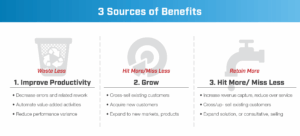
What, then, are the three chief sources or “buckets” of specific benefits for your professional services firm’s transformation? Briefly, they are:
Bucket 1: Heightened productiveness. Today, the knowledge workers in your professional services firm are doing a lot of work, every day. But process improvement—one of the many virtuous byproducts of transformation—will repair the broken processes that are currently hiding in plain sight. They will be re-organized and, whenever possible, reduced. Now layer in the productivity gains from agentic AI and automation in professional services, and you can grow scalable capacity anywhere from 26 to 41%.
And when waste is reduced, so are errors. See how all of this positively impacts the client experience?
Bucket 2: More margin retained. Real-time margin visibility on a per-project, per-client, and per-employee basis is now achievable through natural language queries. Advanced analytics systems
enable this capability: Data intelligence can lead to more profitable pricing of new engagements, as well.
Bucket 3: Increased sales. Transformed professional services operations data is a powerful lever. It lets professional services leaders, along with management and line staffers (as applicable), segment customers in all new ways. It illuminates opportunities for land-and-expand engagements. It helps with up-sell and cross-sell. And it delivers powerful market and segment analytics that your marketing and sales teams can use to improve daily and annual performance.
And these are just the “buckets” of benefits available from transforming business processes and data in professional services. Stay tuned: Specific benefits are coming, further down in this article.
Implementation Framework
Best Practice Process for Transforming a Professional Services Firm
The Lab has helped professional services firms with enterprise transformation for more than three decades. We can help you transform in under a year, with quantifiable gains in both KPIs and margin.
The transformation process can be structured by addressing four essential questions:
Question 1: What is getting transformed in our professional services firm?
To improve client project delivery, and margins, there are three key areas that you will be looking to transform:
1. KPIs for Executives: Advanced analytics, served up on-demand or automatically reported via KPI triggers, turn data into improved executive decision-making. The “vital few” KPIs for professional services executives provide overall organizational health at a glance.
2. Standardized business processes: All end-to-end internal processes and client journeys will be streamlined, improved, and optimized for greater efficiency.
3. Increased automation: Organizations with existing automation initiatives can accelerate those efforts through comprehensive transformation. Routine tasks should be allocated to digital workers while staff focus on strategic, high-value activities.
Despite the promises dangled by technology vendors over the years, there is still a lot of “human glue” holding different systems together in your professional services firm. This is why many leaders’ earlier attempts at process improvement have stalled.
However, when you transform your professional services with standardization, advanced KPI analytics, and AI automation, you can realize the productivity gains that may have escaped you before.
But to do that, you will need to craft a to-be state for each business line, from end to end. You will need to list out what is required to get there. And you will need to make your data automation-friendly.
Question 2: What are the four steps for starting a professional services business transformation?
Here is what you need to do, in order:
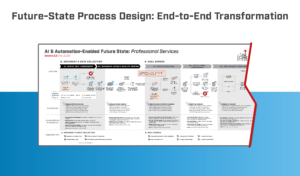
Professional services transformation Step 1: Create a to-be processes map.
To get to your designed end state for your professional services firm, you will need to map it. Think of what you need to accomplish and then draft that as you map; you do not have to worry about the “how” at this point.
To close gaps, you can use a best-practice inventory to help you document the optimum future state. (Fortunately, The Lab can provide your professional services firm with a best-practice survey when we perform current-state process mapping; more on this shortly.) Armed with this inventory, you will see where the improvements lie: you will see them in standardization opportunities, plus areas where AI and automation can step in.
The Lab has templates to make this part easy.
Professional services transformation Step 2: List the fixes.
This step is about closing gaps between your professional services firm’s future-state aims and its current-state capabilities. You will need to list out what is being done, by whom, and with what tools. You will want to identify what policies are in place, and what level of engineering will be needed to ensure automation-readiness.
Specifically, you will want to create standardized inventories of input documents. You will want to list out all data that is used, how it is used, and where it is coming from. You will also want to standardize things like templates, conventions for file names, and procedures for managing priorities and “firefighting.”
Professional services transformation Step 3: Standardize your data for automation.
Remember the “vital few” Executive KPIs for Professional Services firms we had mentioned earlier? Here in Step 3, you will use those to track down the data that must become automation- and analytics-friendly. Identify all sources, fields, and data tags.
Then you can implement the Standard Data Model from The Lab, using The Lab’s templates to speed up the effort. You can learn more about Executive KPI analytics and data intelligence services from The Lab here.
The Lab even has a 3-minute video about advanced analytics, paired with automation, for a professional services firm, which was used to reduce DSO (days sales outstanding) and speed collections on thousands of open invoices; you can watch that video, from The Lab’s YouTube channel, here.
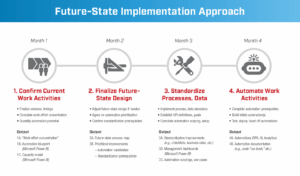
Professional services transformation Step 4: Get the support you need.
Treat your professional services transformation with a project-management approach. Use your requirements to create a workplan which lists everyone and everything you will need to succeed.
Some of this is straightforward. You will need subject matter experts (SMEs) to spearhead the effort from each business unit in your firm. You will also need to enlist the help of their counterparts in IT.
Some of the “resourcing requirements” may surprise you… by their absence. You will not need to replace any of your core systems to transform your professional service business. So, you can retain your existing professional services automation (PSA) platform, your ERP and CRM, not to mention ancillary systems like MS Office. This is because new, transformational technologies such as agentic AI and automation/digital workers act as enablers for these legacy systems. They reside at the front end, facilitating more and better output at the back end.
Question 3: What is the biggest obstacle to transforming my professional services business?
Transforming a professional services firm is a big undertaking. This often leads organizations to attempt comprehensive solutions without strategic focus. In their excitement of the endeavor, they tend to over-engineer it. They use too many people. They add too many unnecessary layers. They require too many superfluous reviews and reports.
Do not put technology before process; that is another common pitfall. Always go process-first. This, plus avoiding the tendency to over-complicate things, will help your professional services transformation to proceed smoothly.
Question 4: How can you guarantee measurable benefits from professional service transformation?
There are three boxes to check when it comes to ensuring real results from your professional services transformation initiative.
- Detailed budgeting: Map out your budget according to what you are transforming (such as workflows, processes, KPIs, bots, etc.) vs. where you are doing it (such as business lines). Following processes lets you transform from wall to wall without any artificial constraints. Reflect this in your budget.
- C-suite sponsor responsibilities: As the executive sponsor of your professional services firm’s transformation, you need to not just keep pace with updates, but actually stay ahead of them. The Lab makes what seems impossible, easy. We provide executive sponsors with previews of updates in advance. This lets you see what is happening, get enough details to communicate and delegate effectively, and pre-empt any internal pushback you may encounter. It also keeps you out of the weeds, where you do not need to be. Therefore, it lets you be proactive, directing the effort instead of reacting to updates. And it helps you keep the end goal in sight for the entire enterprise.
- Organization-wide continual communication: As a professional services firm leader, it is your job to spread the word. Share the wins. Videos are a powerful tool. Create one, for example, showing a robotic process automation or RPA for a professional services “Collections Bot” that automatically notifies project managers and Accounts Receivable of past due invoices… and even uses their replies to its messages to update the Accounting Team’s Accounts Receivable Management tool. Share videos like this one—which showcase the elimination of manual drudge work that everyone hates—to generate enthusiasm for the transformation. Use each communication channel at your disposal. These include your quarterly town hall meetings; they are great for showing quick videos, presented directly by your transformation champion SMEs. There are also newsletters; highlight the people behind the wins. And there are executive emails to the entire team, with the CEO setting the tone. Regardless of the medium, be sure to always keep the broader strategic goals in context. This helps to avoid pushback in the face of change
Detailed Benefits
Top Five Benefits of Professional Services Transformation
We had already mentioned the three “buckets” of benefits for your professional services business from transformation, earlier in this article. To refresh your memory, they are:
- Bucket 1: Heightened productiveness
- Bucket 2: More margin retained
- Bucket 3: Increased sales
What are the actual benefits to your professional services business and its clientele?
Getting Started
Your Path to Professional Services Transformation
Based in Houston—with nothing outsourced or offshored—The Lab has been helping professional services firms executives, business unit and technology leads, and internal improvement teams with business transformation for more than three decades. Our patented Knowledge Work Standardization® delivery methodology, paired with our Knowledge Base of templatized client-engagement IP, provides for measurable benefits, ensuring the success of large-scale transformations in professional services. The Lab can transform your professional services business in as little as six to 12 months.
Ready to transform your professional-service firm? Book your screen-share demo with the experts from The Lab: Call (201) 526-1200 or email info@thelabconsulting.com today.