














How to Transform Your Retail Business 4x Faster by Standardizing Processes
Improve retail KPIs such as ATV, inventory turnover, and customer retention rate in just 6 – 12 months
As a retail executive, technology or business unit lead, or part of an internal improvement team, you know the challenges you face, and seek to overcome as part of your strategic transformation. It does not matter if you are running supermarkets, warehouse clubs, specialty store or an e-commerce site. You need to keep pace with inflation and rising operational costs. You need to succeed at omnichannel inventory management. You must maintain data privacy and fend off cyber threats. Then there are the challenges of talent acquisition and retention, supply chain volatility, and shifting consumer behaviors.
You also know that your retail strategic transformation cannot begin without end-to-end process mapping.
What is current state process mapping in retail?
You need to map your workflows, processes, activities, and customer journeys, down to the individual task-level of detail. When you process-map to add automation, you dive even deeper than individual tasks; you will actually map out your knowledge workers’ individual keystrokes and mouse clicks.
This article will assume that you have already done all that. (If you have not, be sure to read up on process mapping from The Lab.) So now you are ready to transform your retail business, including:
- Standardizing retail business processes
- Standardizing retail data
- Adding agentic AI
- Adding/increasing automation in retail
- Introducing/expanding executive and management KPI and predictive retail analytics
You seek to transform your retail business, obviously, to get the benefits. But you also want to address the challenges in your path.
Where to start, what to tackle first, and how to find the time
The Three Biggest Challenges of Retail Transformation
Many retail executives have attempted enterprise-level transformation before. You may be one of them. If so, you may know that it is not easy. Many executives consider it almost impossible.
Given the stakes, many retail leaders overcorrect toward caution. They over-engineer the effort and over-invest, and they end up with minimal benefits.
But you can choose a more effective path. Here are the three biggest challenges to retail transformation, and how to overcome them:
The measurable gains retail leaders can expect
The Benefits of Retail Transformation
Retail performance, spanning sales, inventory management, customer metrics, and profitability, is all about operational efficiency. You want to transform your retail business because you want operational efficiency that increases profits and performance, along with elevated customer experience.
The Lab has helped businesses like yours to transform, replete with increased efficiency, heightened customer experience, and more margin, in just six to twelve months.
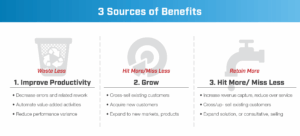
Take a page from those play-books. Focus your retail transformation on the following benefit streams or sources:
Increased productivity (reduced waste):
A lot of the retail transformational improvements you will encounter in this article affect your team’s work, at a granular level, every day. Business and process improvements will increase efficiency by optimizing the order and organization of activities; paired with retail robotic process automation and agentic AI, they often cut down on the actual number of steps required. This reduces wasted effort. Importantly, it can increase retail organization capacity 26-41%.
A hidden benefit: Automated processes eliminate things like typos and human error. That translates to better customer experience, along with better compliance, and reduced risk. As we had said, it just keeps getting better.
Increase sales:
Retail success is all about sales. Retail transformation empowers them. Turn data to your advantage, with AI, automation, and advanced analytics and data intelligence in retail. When you transform, you empower more sales via improved models for customer segmentation; insights that find and accelerate upsell opportunities; and better data to equip your marketing and sales teams.
Retain more margin:
When you transform your retail business with data intelligence, you will gain visibility, in real time, into margin by customer, by supplier, by segment, by geography, by SKU… you will have ways to slice and dice the data that you never had before, serving you up with actionable insights that preserve more margin from every hard-earned retail dollar.
But now we can dive deeper. There are five separate retail transformation benefits to be gained. Specifically, they are:
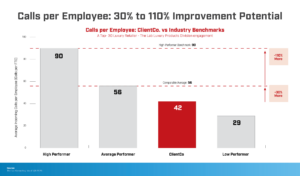
Increase productivity 26 – 41 percent:
Retail transformation removes hidden inefficiency. It surfaces productivity that was previously lost. Improvements occur at the individual task level. Wasteful rework, error correction, and customer over-
service all disappear. Then automation raises productivity further. Taken together, this creates retail productivity improvements of 26% to 41%.
Read how a Top-30 global luxury products retailer, with the CFO as The Lab’s sponsor, was able to:
- Reduce operating cost by 20%
- Improve service by up to 60%
- Increase productive capacity up to 25%
- Achieve annual savings of $3.5 million
- Break even on the initiative in 6 months
- Realize a 12-month ROI of 4x
Read the full details in this retail transformation case study from The Lab.
Elevated customer experience:
No industry is as customer-focused as retail. When you transform your retail enterprise, you will earn improved net promoter scores or NPS, along with better customer retention rates (CRR) and customer lifetime value (CLV).
Your redesigned future state lets you improve the customer experience at every interaction. You will eliminate points of friction and call-center volume. You will reduce churn. And you will be able to win a higher percentage of not just average customers, but ideal customers.
Reduced risk/enhanced compliance:
Imagine a world in which your retail enterprise commits fewer errors. It is a world in which processes are unified, clarified, consistent, repeatable, and audit-friendly. Standardization of operational processes reduces (or eliminates) variance. Better controls reduce risk. Automation not only adds speed; it eliminates human error and typos.
All of this adds up to protecting the business, its customers, and their personal information. These are the bedrocks of improved compliance and risk management.
More operating leverage:
This benefit is all about sustaining operational resilience and process efficiency. Retail “resilience,” in this context, means that you can handle surges (think: Fourth Quarter/holiday season) as well as dips in volume with the same number of people. No more desperate seasonal hiring. No more off-season layoffs.
Once your retail processes and data are standardized for automation, you will enjoy increased scalable capacity. That benefit alone is worth the retail enterprise transformation.
More engaged employees:
Properly implemented automation makes your workers’ lives easier, more productive, and more fulfilling. They will love to see those detested tasks taken off their plates.
Similarly, streamlined workflows, aligned to clearer roles and responsibilities, let your retail team serve your customers better, in a virtuous cycle. And you will elevate your business into one that is sought-after by candidates who are weighing your retail company as a workplace vs. competitors. You will attract stronger candidates and strengthen your workplace reputation.
What to transform, where to start, what to avoid, and how to secure ROI
How to Transform Your Retail Business: A Four-Question Framework
When you follow the best-practice steps below, with help from The Lab, you can transform your retail business in under a year. How can we make a confident claim like that? We have been helping businesses to transform, using our patented methodology, since 1993. We can help your retail business, too. You will see quantifiable benefits in both your margin and retail KPIs.
The best practice transformation methodology is guided by the answers to four essential questions:
What should I transform in my retail business?
This is the burning question that retail executives often ask first. The answer is threefold:
- Standardize retail business processes. Here, you will increase consistency while simplifying processes.
- Transform retail Executive KPIs. Executive KPIs differ from retail management KPIs in that they represent the “vital few” needed to gauge the business’ overall health, and deliver decision-making insights that you can act upon.
- Add (more) retail automation. This is all about liberating your people to do more fulfilling, value-adding, and customer-facing activities, with the digital workers doing all of the rote, repetitive work that your people have always hated doing.
Despite the advances in systems that your retail enterprise uses every day, including POS, IMS, CRM, data lakes, shared drives, and even Excel and Outlook, the different ones do not talk to each other. That means that people are required to “hand hold” the different platforms, in an efficiency-smothering setup. No wonder there has been so little progress in process improvement when all of these patches are in place.
Now add standardization to this mix. It enables that long-sought transformation, and the strategic improvements that underpin it. It enables real automation, along with KPIs from a single source of truth. And no more “human glue” holding different systems together.
This has prerequisites. They include the design of the future state processes, with a detailed understanding of each; and data prep to make it automation-ready.
Where do I start my retail enterprise transformation?
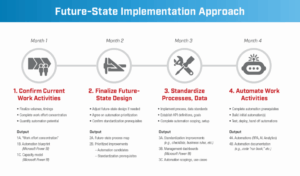
Answer this question by following this four-step process:
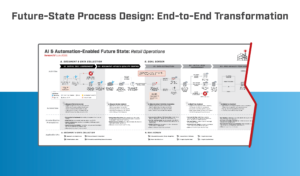
Create a to-be process map:
Here is a counterintuitive tip: Create your future-state retail process map without worrying about the “how.” Just draw out how you want those processes to look.
To make sure it is the best it can be, use a survey of industry best practices (provided by The Lab when we do process mapping) to find and close gaps. You will end up with a list of improvements to implement, along with tasks that can be automated, and sometimes, eliminated.
The Lab, thanks to our Knowledge Base, has templatized best-practice process maps to make this step easy.
Gap-test vs. current state:
You listed out your to-be goals. Now you need to compare them to your existing capabilities and processes. Now you want to document what is required to close the gaps between the current and future states. These include activities that are undertaken; the policies that are used and maintained; and the systems and tools employed. It also encompasses prerequisites such as work assignments (which person performs what activity) and whatever engineering will be required to allow for AI and automation in the retail future state.
Drilling down, you will want to list out the standardized documents needed; the standardized storage and organization of data you will collect; and things like naming conventions, templates, and procedures for retail data triage.
Use Executive KPIs to “back into” a standardized data model:
List out the Executive KPIs you will need to manage your to-be retail state. Then use this list to identify what is needed for advanced analytics and automation, such as:
-
- Data sources
- Data fields
- Meta tags
Thanks to The Lab’s Knowledge Base, there are templates to help you implement the standard data model for your retail enterprise.
As a retail executive, you probably do not think about banking as a peer industry. Yet every bank operates retail branches which face similar challenges. Check out these related videos from The Lab which show Executive KPIs in action in retail banking:
Line up the required resources:
Now that you have your goals and retail requirements, you can create a work plan for your retail transformation. But what kind of support will you need? Importantly, what you do not need?
What is required: SMEs.
You will need to identify subject matter experts or SMEs from within your retail enterprise to spearhead the transformation within each discrete line of business. You will also want to tap their counterparts in your IT organization.
Do not over-engineer the process. Sure, you can layer in other people, e.g., from Risk and Compliance, to review your future-state operation, but keep the core team lean. Avoid unnecessary layers, approvals, and reviews.
What is not required: A core system rip-and-replace.
Many retail leaders fear that “transformation” implies “all new systems.” That is a daunting prospect, especially given all the systems you have already invested in, including your POS (point of sale), CRM (customer relationship management), IMS (inventory management system), e-commerce platforms, and others.
New technologies, such as robotic process automation or RPA for retail, and certainly agentic AI for retail, eliminate the need for new systems. They work with your existing core platforms, adding new capabilities to them. Think of them as an “upgraded front end” for your extant systems. So, fortunately, you will not need to invest time, cost, or risk in a major software upgrade or replacement.
What kinds of issues could delay my retail enterprise transformation?
There are certainly pitfalls to avoid when it comes to transforming your retail enterprise. Do not put technology before process. As we had noted earlier, do not over-engineer your retail transformation. Avoid extra layers, extra people, extra reviews.
Be pragmatic. Keep the pace agile, consistent, and repeatable. Sure, the stakes are high, and so the temptation to over-work it is there. But do not lose sight of the goal; aim for a basic process that you can lather-rinse-repeat.
How can I ensure the ROI and benefits of my retail enterprise transformation?
As a retail executive, there are more requirements you will need to meet to keep the transformation on track, and deliver measurable benefits:
A fully fleshed-out budget:
Build your budget around processes, not locations. You will want to budget for what, in your retail business, you are transforming, not, for example, where it is being done.
You will be transforming (and budgeting for) things like automation, process improvements, and Executive and management KPIs. Do not fall into the trap of budgeting by business area.
Why? When you follow the process, you go where it takes you. And that may well span multiple business areas. That is fine. Give yourself, and your budget, the flexibility you need to follow, and improve, processes and data from end-to-end. Your retail business transformation budget should be detailed accordingly.
Future-informed executive sponsoring: As a retail executive, it is not enough to receive updates from your team. Ideally, you want to be updated before the updates.
It is possible. It is simply the way that The Lab works with our executive sponsors. Rather than reporting from the bottom up, we report from the top down. We provide what we call executive previews directly to sponsors.
This gives you immediate visibility into the process, without the need to get into the weeds or micro-manage. It also arms you against pushback within the ranks.
Without the need to wait for updates from below, you can lead from above. You can stay focused on execution, being proactive instead of reactive. And you can keep the goal in sight for the entire retail enterprise.
A constant communication plan:
Transforming your retail enterprise is not something that should happen in silos, or in a corporate vacuum. You will want to get the word out, early and often. Here are some tips:
-
-
- Make videos. Nothing showcases the power of robotic process automation in retail like a quick demo video of a labor-saving retail bot in action; you can use the initial prototype for your video before the full bot goes into production. Want to see examples? Look no further than The Lab’s YouTube channel.
- Use emails and newsletters. Keep the messaging upbeat and terse. Showcase wins. Call out the champions. Newsletters are a great “broad” platform; when it is time to focus, nothing compares to an email directly from the CEO, establishing the right level of confidence and encouragement, while keeping the goals in sight and tacitly pushing back against any organizational inertia.
- Put town halls to retail transformation use. Do not create “retail transformation” town halls; simply dedicate a portion of your existing town halls to retail transformation. Fifteen minutes should be sufficient; let your transformation champions showcase wins, and of course, share those videos.
-
Proven results in as little as six to twelve months
Transform Your Retail Business With Help From The Lab
Over the course of more than three decades, The Lab has helped retail executives, technology leads, and internal improvement teams to transform their enterprises with quantifiable benefits in accelerated timeframes. Our industry-leading Knowledge Base of 30-plus years’ worth of templatized, re-deployable client-engagement IP, along with our patented Knowledge Work Standardization® delivery methodology, can transform your retail business in just six to 12 months. And all of The Lab’s work features 100% U.S.-based delivery, with our entire team based at our headquarters in Houston.
Ready to transform your retail business? To schedule your screen-sharing demo with our experts, simply call (201) 526-1200 or email info@thelabconsulting.com today.