













How to Standardize Your Supply Chain Business
Boost productivity by 24% – 41% while increasing the penetration and effectiveness of AI, KPI analytics, automation, and overall operational efficiency
The Hidden Cost in Your Supply Chain
Why 35% of knowledge work is virtuous waste and what to do about it.
As an executive or technology lead at a supply chain business, you understand the operational challenges, such as global trade disruptions, rising freight costs, limited end-to-end visibility. These pressures are consistent across supply chain models (lean, push, pull, e-supply, global) and industries (automotive, manufacturing, retail, pharmaceuticals). These are headwinds you face as part of a supply chain internal improvement team, too.
All of these challenges require transformation. Transformation, in turn, requires best-in-class operational improvement.
But where are the opportunities for improvement? Your knowledge workers are typically working at full capacity, making new efficiencies difficult to identify.
In our more than three decades of working with supply chain, manufacturing, and distribution clients—and capturing all of that engagement IP into our semantically structured Knowledge Base—we at The Lab have uncovered some interesting truths:
- Knowledge workers spend over 35% of their time, every single day, on duplicative activities, fixing errors, and needlessly over-serving customers.
Reading this, you surely see it as waste. But they don’t. They think it’s both necessary and unavoidable in supply chain operations.
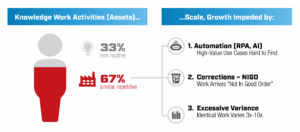
In fact, they believe this “work” is laudable. That’s why we call it Virtuous Waste. Think of it as a road paved with good intentions, which hardly leads to paradise. They don’t perceive Virtuous Waste as a cost. But it is.
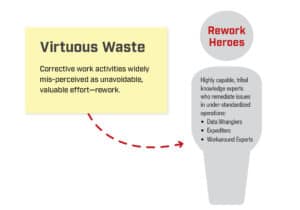
This assumption is incorrect: Virtuous Waste is not an unavoidable cost of supply chain operations.
Three Assumptions that Block Supply Chain Efficiency
Challenging the ‘assumed truths’ that prevent standardization.
If you challenge three distinct assumptions in supply chain businesses, you can standardize operations and recoup earnings on the order of 20% or greater. So just because the following three “assumed truths” may have been “the way we’ve always known it,” doesn’t mean that they’re true:
First supply chain assumed truth: Our business is unlike any other supply chain business
Technically that may be correct, but in practice, it’s not very helpful, or true. Your processes, workflows, and org structure are, in fact, quite similar to those of other supply chain businesses.
Second supply chain assumed truth: There’s no way you can standardize what we do
If this were really true, then this article couldn’t exist. Guess what? Over 67% of your supply chain operational activities are ripe for standardization, right now. In other words, there’s a ton of inefficiency and redundancy hiding in plain sight.
Third supply chain assumed truth: We can simply automate everything via new tech
Third supply chain assumed truth: We can simply automate everything via new tech. Ah, if this were only true; we all know the siren song of shiny new technology. But consider these salient points:
- If you fail to eliminate your supply chain Virtuous Waste, then you’ll simply migrate it from your older technology to your newer technology. Thus, zero improvement.
- Some 76% of existing supply-chain knowledge work improvements don’t need any new technology to be implemented. (Don’t believe us? Check out this classic 5-minute YouTube video from The Lab.)
The Lab has created—and patented—a methodology for eradicating Virtuous Waste in supply chain businesses; it’s called Knowledge Work Standardization®. Not only does it identify and reduce this insidious inefficiency, but it paves the way for the transformational technologies we know you want (or want more of), including agentic AI, digital workers (also known as robotic process automation or RPA in supply chain operations), KPI analytics, and advanced data intelligence.
All of the above is predicated on your ability to standardize your supply chain business, at every pillar of the Supply Chain Operations Reference or SCOR model of Plan, Source, Make, Deliver, and Return. So let’s learn more about standardization in supply chain operations.
Knowledge Work Standardization: The Foundation for Transformation
Process-first methodology and critical implementation guidelines
Let’s start with a definition:
For supply chain businesses, “Knowledge Work Standardization” refers to a process-before-technology approach to standardizing workflows which unlocks the power of tech to help supply-chain C-suite leaders to increase scalable capacity and operating leverage, while elevating enterprise value.
Knowledge Work Standardization enables more effective use of agentic AI, digital workers, and predictive KPI analytics. This delivers both operational process improvements and enterprise-wide strategic transformation benefits.
When you standardize your supply-chain business, you will:
- Retain more profits. Reap up to 2.5 points of additional margin.
- Be best-practice productive. Reduce Virtuous Waste, while increasing productivity by 24% to 41%.
- Sell more. Using advanced analytics for marketing and sales, you’ll be able to better segment markets and customers, which translates to more upsell/cross-sell performance from your sales team, not to mention prospecting among riper targets.
A major pitfall in supply chain standardization is “false precision”, which is demanding excessive detail without clear justification.
There are parallels here. As The Lab’s forthcoming article about process mapping for supply chain operations makes clear, while you certainly need to map out your as-is activity state, you needn’t map every single microsecond thereof. And while you need to reveal the opportunities for improvement, you don’t have to quantify them all to keep the project moving forward.
When it comes to standardizing your supply chain business, the task at hand is to ID what needs standardizing, upstream. It’s not zooming in on the microscopic metrics of how long each task requires. That’s the epitome of “false precision” in supply chain businesses.
Scope and Scale: What to Standardize
The five w’s and Level 4 workflows in supply chain operations.
As you seek to transform your supply chain business and reap all the benefits thereof, you’ll want to ask, and answer, what are often called the “Five W’s” of supply chain standardization first:
- What is getting standardized? You’ll want to standardize all processes and supply chain data, from end to end.
- Who gets standardized? This will include each supply-chain function and department through which processes and data transit.
- Where’s the standardization? Your supply chain standardization effort should touch each system which the processes and data employ.
- Why standardize? It’s the single best way to attain the most benefits. Be sure to show its worth as an essential prerequisite to transformation, in order to quell dissent among the rank-and-file.
- When do we standardize? The Lab’s Knowledge Work Standardization methodology can deliver supply chain end-to-end standardization in just six to 12 months.
For true wall-to-wall/E2E supply chain standardization, be sure to include the deep-dive data and activities. These are often called Level 4 activities and data: the activities reside at the 3 to 5 minute duration level, along with the data they use, input, develop, and export. They’re not the process; but they’re constituent elements.
You will want to map every one of these Level 4 supply chain activities to shine a light on their components, gauge what’s known as their work/effort concentration, and figure out the to-be state for each.
This same approach applies to your data, which exists across multiple systems. It’s residing not just in your data lake (if you have one), but core systems such as your transportation management system or TMS, your enterprise resource system or ERP, warehouse management system or WMS, supply chain planning (SCP) and optimization platform, supplier relationship management (SRM) platform, and others. For your Level 4 data in these systems, you will want to identify its source, define it, and model it, so that it’s automation-compatible, and optimized for the to-be state in your supply chain operation.
Five Transformational Benefits of Supply Chain Standardization
From data dialogue to customer experience elevation.
Standardizing your supply chain business, regardless of its operational focus (lean, e-supply, etc.) or industry (retail, pharmaceuticals, manufacturing, etc.), comes with these top five benefits:
- Supply Chain Benefit 1 from Standardization: Enable data dialogue. When you standardize your supply chain business, you’re no longer at the mercy of arcane reports which require an expert just to interpret. Simply chat with your data, just like your smartphone assistant. You’ll get the newest data, from the single source of truth; it can reply to your English-language text or voice queriesin English; it can also auto-push out data to you at intervals or KPI thresholds of your choosing.
- Supply Chain Benefit 2 from Standardization: Automate even more. Everyone knows about pick-and-pack bots in supply chain operations. But here, we’re talking about automating higher-value sit-at-the-computer work. When you standardize your supply chain business, you can automate 20, 30, 40, even 50 percent of knowledge-work activities. And the more you automate, the more you—and your human workers—benefit.
- Supply Chain Benefit 3 from Standardization: Boost compliance. No supply chain executive wants to lose sleep over a gap-filled audit trail. With standardization, activities become automated, consistent, visible, error-proof, and audit friendly. That not only increases compliance. It reduces risk, too.
- Supply Chain Benefit 4 from Standardization: Elevate customer experience. Standardization enables superior customer experience regardless of company size. Consistent, error-free processes create smoother interactions and stronger customer relationships.
- Supply Chain Benefit 5 from Standardization: Empower your people. When you standardize supply chain operations, you remove the barriers to employee performance and unlock their potential. This leads to higher job satisfaction and retention, making your business more attractive to top candidates.
Executive Leadership Requirements
Three must-haves for C-suite transformation success.
As an executive at a supply chain business, you want to make the most effective possible use of top-down leadership for your transformation initiative. Here are three tenets to guide you:
1. Make “Standardization” a key strategic priority. This is a big deal; make sure everyone knows it. Standardization should be one of the top three priorities across the enterprise. Get the word out. Make videos of automations, made possible via standardization, and share these wins across the business and its intranet. Show them in town halls, newsletters, and emails directly from the CEO’s desk.
2. Nominate your champions. Impanel Process Champion groups and tribunals, populated with respected peers who will make sure that your supply chain standardization effort is met with success.
3. Focus by function, not by business. Make the initiative follow process-first logic, so it can organically proceed, crossing in and out of individual business units (and silos) as needed.
Your Six-Step Implementation Guide
From as-is process mapping to data standardization.
To maximize your odds of success, follow these steps in order:
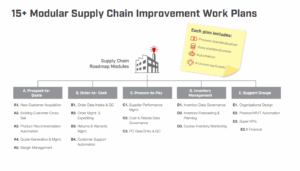
1. Begin with the as-is process map. You’ll need to map out all of your supply chain business’ extant business processes, end-to-end and/or wall-to-wall. While this may sound daunting, The Lab offers wall-to-wall supply chain process mapping as a service, thanks to the power of our templatized Knowledge Base, and deliverable in just 6 to 8 weeks.
2. Classify supply chain workflows. Organize them into an enterprise-wide classification system (a.k.a. taxonomy). Discrete activities should be tagged with a) volume of work, b) who does it, and c) the time required to perform it. The Lab’s templates will accelerate this work for you.
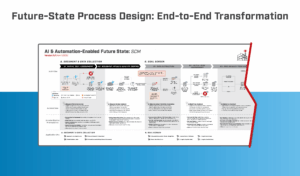
3. Graph the future state. Just as you had a map for the as-is state, you’ll need to create one for the to-be state. But, counterintuitively, you won’t use your current-state map to create the future-state one. At this point, it would simply be a distraction. Rather, create a “Christmas list” of what you want your supply chain business to be able to accomplish. Then compare it to your outputs from the previous two steps, and voilà! You’re done.
4. List out your Exec KPIs. These are your Executive Key Performance indicators, which provide an “MRI” of your supply chain business’ health, and the effective execution of all processes.
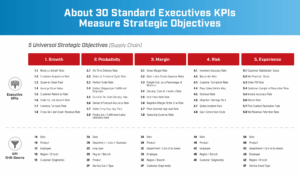
Get a jump-start on this activity with the “vital few” Executive KPIs for Supply Chain leaders, available directly from The Lab, and essential for effective scaling of your operation.
5. Track your data to the source. Every single data element originates somewhere, be it your ERP, CRM, WMS, TMS, SCP, SRM… there are a lot of three-letter acronyms in the supply-chain universe. So you’ll have to tease apart
each data element into its parts, and trace them back to each disparate system and/or repository.
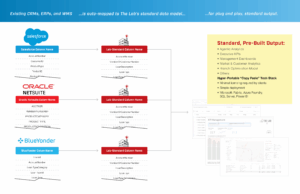
6. Standardize all supply chain data. Your Step 5 data now needs to be cleaned, mapped, and “ETL’ed” (extracted, transformed, and loaded) into The Lab’s Standard Data Model, which is easier than it sounds, because we have templates for this step, too.
Partner with The Lab for Accelerated Results
Standardize supply chain operations with proven methodology.
The Lab provides numerous different engagement models for supply chain executive sponsors. We offer process mapping, data standardization, and templatized/rapid-rollout solutions for process improvement, automation, analytics, and agentic AI. All of these offerings are underpinned by our passion for standardizing knowledge-work data and processes across your supply chain business, streamlining your progression toward more immersive adoption of automation and AI across the enterprise.
Get started on your supply-chain standardization success story. Schedule your screen-share demo with the friendly experts from The Lab; simply call (201) 526-1200 or email info@thelabconsulting.com today.