













Transform Your Supply Chain Business: A How-To Guide for Executives
Improve KPIs across customer/delivery, inventory/warehousing, and financial/procurement, preserving margin while increasing velocity
Transform Your Supply Chain Business: A How-To Guide for Executives
Improve KPIs across customer/delivery, inventory/warehousing, and financial/procurement, preserving margin while increasing velocity
As a supply-chain executive, business-unit leader, or member of an internal operational improvement/excellence team, you face a raft of strategic transformation challenges. It doesn’t matter which industry you’re in, such as automative, manufacturing, retail, e-commerce, fashion/apparel, pharmaceuticals, or others. And it doesn’t matter which supply-chain model drives your business, be it lean, push, just-in-time/pull, e-supply, or global. Your goals are the same: Preserve more margin, attain measurable improvement in vital supply-chain KPIs, and better serve your customers, whether they’re external or internal.
The foundation every supply-chain transformation depends on
Supply-chain transformation begins with as-is process maps
Knowledge Work Transformation™ for supply-chain leaders (more on this in a moment) relies on the bedrock of an end-to-end (sometimes called “E2E”) baseline process map of your “as-is” supply chain business today. This should encompass all six pillars of the Supply Chain Operations Reference or SCOR model, including Plan, Source, Make, Deliver, and Return—depending upon the role(s) your organization plays.
The Lab has a helpful how-to article for process-mapping the 3PL/4PL logistics focus of supply chains; check it out here. The Lab also has lots of helpful videos showing process mapping and other transformation services; you can find them all on The Lab’s YouTube channel.
What, then, should you map in your supply-chain organization? You’ll want to document all of your E2E activities, processes, and customer journeys; as-is process mapping is the prerequisite for transformation in supply chain businesses.
The as-is process map needs to be detailed: every task, every action, every activity. You’ll even need to document individual keystrokes and mouse-clicks, when it’s time to layer in agentic AI and robotic process automation (RPA) for supply chains.
Once your as-is process maps are complete, you’ll need a single repository of data to draw from. That’s because your supply chain transformation will include:
- Standardizing and normalizing all supply-chain processes to best practice improvement
- Up-leveling supply-chain analytics with standardized data
- That data needs to be “standardized for automation,” in order to introduce, or accelerate, your adoption of agentic AI and automation
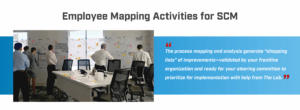
Once you have your current-state process map(s) and single source of truth for supply chain operations, you’ll be poised to face the challenges—and enjoy the benefits—of supply-chain transformation.
What stands between your supply chain and real transformation
What are the biggest challenges to transforming my supply-chain operation?
Supply-chain executives and their internal improvement teams are no strangers to transformation… attempts. Many supply-chain leaders have a tendency to over-engineer the tasks, yielding minimal benefits, if any. Battle-scarred, they’re often reluctant to try again.
But transformation in supply chain businesses is possible. You simply need to recognize the challenges you’ll face:
Supply Chain Transformation Challenge Number 1: Establishing priorities
Once you’ve created the current-state process maps of your supply chain business (as you’ll recall, this is the essential prerequisite to transformation in supply chains), you’ll have an “embarrassment of riches” when it comes to implement-able improvements:
- Basic improvements are on the order of standardized templates and checklists for daily tasks.
- On the more complex end of the continuum, they could feature AI and RPA, actually taking requests and performing them, too. For example, agentic AI could serve as a process’s new front end, with automation in the background doing the heavy lifting for your knowledge workers.
Given all of the potential benefits arrayed before you, it can make your next decision seem tricky. Where do you start? You certainly want to improve every pillar of the SCOR model.
The answer is intuitive: Begin where the process begins. Then progress, well, progressively.
This will work, helping you to transform your supply-chain operation, because the input has an outsize impact on the output. So clean up the front end of your processes first; you’ll reap tons of benefits downstream at the same time.
Think of just the “Deliver” pillar of the SCOR model, encompassing logistics, warehousing, and transportation. By standardizing the tools, data, and activities therein, you can:
- Reduce points of employee and customer friction across the process.
- Cut down on rework activities by 26 to 41 percent.
- Scale up the entire “Deliver” process with additional automation.
- This straightforward approach provides both benefits and momentum. And it’s replicable, across the organization and its different processes.
This straightforward approach provides both benefits and momentum. And it’s replicable, across the organization and its different processes.
Supply Chain Transformation Challenge Number 2: Using your as-is process map
Many supply-chain executives have trouble knowing where to start their transformation process. But now you know: Transformation to the future state hinges on an intimate knowledge of the current state. And where does that reside? Of course: In your current-state process map. We can’t stress this point enough.
The Lab has a discrete capability in process mapping and improvement; read more about it here.
Your supply chain current state process map gives you the transformation-enabling visibility you need into:
- What is happening in your supply-chain organization
- What is working in your supply-chain organization
- What is not working (and why) in your supply-chain organization
- What is required for improvement in your supply-chain organization
Remember “tricky”? Now you can forget it! When you have the right information, a.k.a. your current-state process maps, in hand, your path forward is neither obscure nor daunting.
Supply Chain Transformation Challenge Number 3: Overcoming obstacles
Many supply-chain executives are reluctant to attempt a transformation initiative for the simple reason that they fear it will grind the daily organization to a halt while doing so.
Supply chain C-suite leaders and their teams that work with The Lab, however, have learned that their businesses can keep chugging along, productively, amid the very transformation they envision. In other words, you needn’t sacrifice operational productivity to effect your supply chain transformation. The Lab has been helping organizations just like yours for more than 30 years; we’ve never once forced them to hang a “Sorry, we’re closed during transformation” sign on the door!
The key to this seemingly impossible trick is The Lab’s Knowledge Base. It’s able to accelerate your supply-chain transformation via templates, based on actual client-engagement IP and best practices, with templates for:
- Data maps
- Process maps
- Best practice
- Executive and Frontline Management KPIs
- Agentic AI & RPA automation use-cases
- Automation bot code
- Others
Most of these pre-built templates are “drag-and-drop” friendly, so you can implement them 4x faster than if you were trying to add these improvements from scratch. Not only do the templates make implementation go faster; they also free up supply-chain resources which you can devote to the transformation. It’s like the gift that keeps on giving.
While the templates are indeed powerful, we don’t want to downplay the actual work required to achieve an organization-wide transformation at your supply chain enterprise. It requires effort, management, and oversight. But this is a classic case of working smarter vs. working harder. Armed with your strategic goals and The Lab’s templates, you’ll be able to chalk up actual benefits from your transformation that much faster.
Where process excellence meets bottom-line performance
What are the key benefit categories of transforming my supply-chain business?
Profitability depends on performance. And both are linked to efficiency in operations. Nowhere is this more apparent than in supply-chain ops. Your transformation journey will include workflow streamlining to increase delivery metrics such as Perfect Order Rate (POR), On-Time Delivery (OTD); inventory metrics such as Days Sales of Inventory (DSI) and Inventory Carrying Cost; and financial/procurement metrics such as Cash-to-Cash Cycle Time, Total Supply Chain Cost, and Supplier On-Time Delivery.
This article will show how The Lab, over the course of more than three decades, has helped organizations just like yours to achieve measurable results in the aforementioned KPIs in as little as 6 – 12 months. But for now, let’s review the three categories of benefits which your supply-chain business can derive from an organization-wide transformation.
(Image)
Supply Chain Benefit Category 1: Grow revenue.
Using technologies such as agentic AI, digital workers/robotic process automation, and predictive analytics, you’ll provide your entire supply-chain team with newfound tools and capabilities, including:
- Novel customer/market segmentation models
- New insights and opportunities for customer up-sales/cross-sales
- New markets and leads for your supply-chain sales and marketing teams, ideal for both strategic planning and daily operations
Supply Chain Benefit Category 2: Preserve additional operating margin.
Imagine having the following capabilities; you can, when you transform your supply-chain business:
- More accurate pricing
- Actual margins in real-time, filtered by product/service/supplier, and more
- Improved risk and compliance
- Better customer experience at every touch-point
- Increased data intelligence
This all adds up to slashed cycle times, greater capacity, cost management across complex supply chains, and improved velocity of operations.
The Lab has published numerous case studies pertaining to manufacturing and supply chains; check them out here.
Supply Chain Benefit Category 3: Increased productivity, end to end.
When you elevate your operations to best practice at every single activity, you’ll truly realize the benefits of transformation in supply-chain ops. The resulting operational improvements will:
- Re-organize your supply-chain activities
- Re-order your supply-chain activities
- Eliminate wasteful supply-chain activities—what The Lab calls “NIGO,” for “not in good order”
Along with the addition of digital workers and agentic AI in supply chain, you can see increased capacity on the order of 26% to 41%. Along with the productivity gains, errors will fall, thus improving risk, compliance, and customer experience… all at once.
Five outcomes that change how your supply chain performs
The 5 biggest transformation benefits for supply chain businesses
In this article, we’ve identified the three key categories of benefits for supply chain business transformation:
- Supply Chain Benefit Category 1: Grow revenue.
- Supply Chain Benefit Category 2: Preserve additional operating margin.
- Supply Chain Benefit Category 3: Increased productivity, end to end.
But what are the actual benefits themselves, downstream of these categories? Glad you asked; here they are:
The “What, Where, and How” of supply-chain process transformation
The Lab has been helping organizations like yours with business and process transformation for more than three decades. With our patented Knowledge Work Transformation methodology, we know how to help you attain the benefits which affect your bottom line and your KPIs.
Certainly you have questions. So let’s dive into the answers to the most common “what, where, and how” questions that our executive sponsors typically pose, prior to a supply-chain transformation engagement:
- What needs to be transformed in my supply chain organization?
- What common traps should I avoid during my supply-chain business transformation?
- Where should I begin transforming my supply-chain business?
- How can I maximize the benefits and value of my supply-chain business transformation?
Let’s dive into the answers for each of the above.
1. What needs to be transformed in my supply chain organization?
To increase the bottom line of your supply chain operation while elevating the customer experience, you’ll need to transform three strategic areas:
- Supply chain business processes standardization. Ensure that every supply-chain business process is simpler, more consistent, and less redundant.
- Executive KPIs for supply chain. You’ll want to leverage your data so that it delivers insights which help leaders and subordinate managers make informed decisions. You’ll need to deploy data intelligence; you’ll also need to identify the vital few Executive Key Performance Indicators.
- Supply chain automation. To enable the maximum productivity in your supply chain operation, you’ll want to employ as much automation as possible, easing the workload on your valued human employees.
While numerous business processes in the supply-chain industry have been updated in recent times, courtesy of new technology, people are still often the “human adhesive” bonding together systems that do not talk to each other. That’s why many process-improvement initiatives fail to deliver on their efficiency-lift promises.
However, when you transform your supply-chain business processes and add standardized Executive KPIs and layer in robotic process automation to supplant the “human adhesive,” you can truly enable strategic transformation across your supply-chain organization.
As we’d noted earlier, this entails first understanding all the needs for your to-be state,
designing the E2E future state for each business unit, and readying your supply-chain data for RPA automation.
2. What common traps should I avoid during my supply-chain business transformation?
One of the biggest pitfalls lurking in the path of successful supply-chain transformations is the tendency to put technology first. Don’t. Put process first. Don’t over-engineer your supply-chain organizational transformation. Establish a practical and agile cadence.
Similarly, don’t over-burden your transformation in supply chain operations with too many layers, too many reviews… too many people. Keep it lean. Keep it simple. The extra layers and reviews will only slow things down, adding a layer of false precision which is only just friction. You want benefits, not layers.
3. Where should I begin transforming my supply-chain business?
Follow this four-step methodology for beginning your supply chain business transformation:
Step 1 for Supply Chain Business Transformation: To-be process mapping
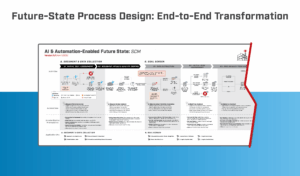
Now’s the time to put your current-state process map into the time machine, and see what the future holds for your supply chain business. Your to-be process map should be clearly documented and defined around the ideal end-state.
At this point, won’t worry about the “how.” It may feel odd, but trust us. Just focus on what you want to achieve.
Use an inventory of best practices to guide your mapping; The Lab provides exactly that, when we process map your organization—a service that we offer to supply chain executives. The best practices, for every phase and activity, will help you identify gaps in your future state—and how best to close them. You’ll get proven ideas for implementing AI and automation, while eliminating wasteful and redundant activities.
If you remember our obsession with templatizing best practices, you won’t be surprised to learn that The Lab also offers templates for future state process maps that you can easily adapt for your specific supply chain business.
Step 2 for Supply Chain Business Transformation: Gap testing
Now is the time to gap-test your supply chain business’ future-state goals against your as-is processes and technologies. Be sure to identify:
- Activities which your team performs
- Systems and tools that your team employs
- Policies which your team must adhere to
- The basic who-performs-what of daily activities
- What must be re-engineered to be automation-friendly
Examples include:
- Standard inventory of documents to collect
- Standard locations/tables for data to collect
- Standard file-naming conventions, plus templates and other supply-chain triage protocols
Step 3 for Supply Chain Business Transformation: Data standardizing
Start with the Exec KPIs for managing future-state performance in your supply chain business. Then use that to identify the specific tags, fields, and data sources you’ll need to render the data usable for data intelligence/automated KPI tracking, as well as robotic process automation/RPA/digital workers and AI.
You’ll use this data to take advantage of the Standard Data Model, available from The Lab. And we have a template (naturally!) to help accelerate this step for you.
The Lab has data analytics videos on our YouTube channel that will make a lot of this clearer for you. Check out any or all of the following:
- Wholesale Distribution Executive KPIs: AI + Automated Data Standardization, Reporting & Improvement: 4-minute video
- Inventory Management AI & Data Analytics: Distributors & Manufacturers, Executive KPIs & Automation: 4.5-minute video
- Supply Chain & Manufacturing Operations: AI & Automation for Daily OEM Reconciliations Reporting: 2.5-minute video
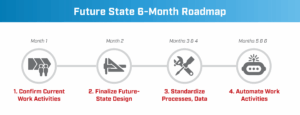
Step 4 for Supply Chain Business Transformation: Resource sourcing
Now you can really roll up your sleeves, using your requirements list to create a work plan, and checklist of resources you’ll need to support your supply-chain transformation, including tools and subject matter experts or SMEs.
- Required resource for supply chain transformation: SMEs. Find the ideal champions within each function of your supply chain business. Locate them by their line of business—and their analogous counterpart in IT. Start with core functions; you can add in others (such as compliance, risk, HR, marketing, etc.) later; all will be needed to review and validate the to-be state.
As we’d mentioned earlier: Don’t over-engineer your effort. Hold back on any temptation to add more checklists or stage-gates. Start with core business/management; add the other layers as needed for refinement.
- Not required for supply chain transformation: New core systems. Here’s great news for your supply chain transformation: You won’t need to rip-and-replace any of your systems, including your transportation management system or TMS, supply chain planning and optimization system or SCP, enterprise resource planning platform or ERP, warehouse management system or WMS, supplier relationship management system or SRM, and others.
This is certainly welcome news, but how is it true? It’s because agentic AI, working upstream, “issues the orders.” The robotic process automation in supply chain operations, working downstream, executes those orders… in the very systems we’d enumerated above. Working in tandem, AI and RPA will work with, and even work around, your existing systems, doing what your extant platforms often can’t do on their own.
4. How can I maximize the benefits and value of my supply-chain business transformation?
There are three keys to attaining measurable benefits from your supply-chain operational transformation, each of which requires diligent application:
First key to maximum supply chain transformation value: Budget.
Don’t arrange your budget by where the transformation is taking place, such as discrete business areas. Rather, classify the expenditures by what you intend to transform, such as processes, Exec KPIs, and RPA automation.
When you budget according to process, you can transform organically from E2E, without the sometimes artificial constraints imposed by organizational boundaries. When you transform from end to end, you end up transforming all of those organizations regardless.
Second key to maximum supply chain transformation value: C-level sponsoring.
As a supply-chain executive sponsor, you need to possess a superhuman-like ability to get in front of the initiative, vs. being bogged down in the operational weeds. You need to continuously provide communication to the organization.
You’re well aware that you lack the time (and likely the inclination) to sit in on all the weekly updates. And while you do want to participate in monthly updates, wouldn’t it be great if you could arrive at those meetings, as the executive sponsor, with the aforementioned superhuman power of knowing the update before the update? If you could do this, you could spend a ton more time directing next steps, instead of merely “catching up.”
It’s actually possible. The Lab provides executive-level previews to sponsors, prior to monthly meetings. We update organizations from the top down, from execs, to middle management, and then to team members. This lets our C-suite sponsors get real-time progress updates at the high level, not in the weeds. Armed with this info when you walk into a meeting, you can easily deflect any pushback or excuses, pre-emptively quashing resistance before it can spread.
This saves time and increases your effectiveness. It also clarifies the next steps, and the end state, for the rest of the business.
Third key to maximum supply chain transformation value: Constant communication.
Use early wins—like your first automation for managing reverse logistics and returns—to build enthusiasm and momentum. Employ every channel at your disposal to communicate with the business.
Create short demo videos of these bots in action; show how it eliminates activities that everyone loathed performing in the past.
As inspiration, here are a few example videos of supply-chain bots in action, initially created by The Lab for our clients, and subsequently anonymized for publication on our YouTube channel:
- Supply Chain & Manufacturing Operations: AI + Automation for Daily OEM Reconciliations Reporting 2.5-minute video.
- Distribution/Manufacturing: Quote-to-Opportunity Conversion AI + RPA Automation for ERP + CRM 4.5-minute video.
- Vendor Invoice Processing AI + Automation for Accounts Payable Robotic Process Automation Demo 3-minute video.
Use your other communication channels to push out wins and enthusiasm as well:
- Supply chain executive emails, directly from the C-suite sponsor/CEO, should draw attention to milestones achieved, congratulate those responsible, and preempt any resistance to change.
- Monthly or quarterly supply chain newsletters, distributed organization-wide, are a great vehicle for highlighting wins, showing pictures of proud team members, and highlighting enthusiastic quotes.
- Town halls (quarterly). You needn’t create separate town halls for the transformation; fold “transformation” into your existing ones. Spend about 15 mins. on its progress, with champions sharing successes and showing short videos. Keep it all within the context of the bigger to-be strategic goals.
Proven results, delivered in as little as six months
Let The Lab help you transform your supply chain organization
For more than 30 years, The Lab has helped supply-chain business executives, business/technology leads, and internal improvement teams with business and process transformation initiatives which yield measurable results and ROI.
Our time-tested and proven solutions—grounded in our Knowledge Base of re-deployable client-engagement IP and patented Knowledge Work Transformation delivery methodology—can help to transform your supply chain business in as little as six months to twelve months.
If you’re ready to transform your supply-chain business, schedule your screen-sharing demo today: Call (201) 526-1200 or email info@thelabconsulting.com.