














Standardize Retail Operations to Increase Productive Performance 26 to 41%
How to use Knowledge Work Standardization® methodology to speed and deepen your adoption of AI, automation, KPI analytics, and retail operating leverage
The operating leverage hiding in your daily retail workflow
Retail Transformation Starts With Standardization
As a retail executive, technology or business-unit lead, or part of an internal improvement team, it does not matter what type of retail business you compete in. It could be brick-and-mortar or eTail. It could be service-based. And you could sell anything from groceries to specialty items to furniture rental.
Regardless, transformation in today’s competitive retail market is based on process improvement, increased operating leverage, and improved scalable capacity. All these improvement opportunities have one thing in common: They depend on standardization.
While we will dive into the details shortly (of what, for example, to standardize), these improvement opportunities are often hidden in everyday operations.
During the more than three decades in which The Lab has been helping companies like yours, we have seen the same in-plain-sight issues affect retail operations repeatedly.
Specifically, as you read this, right now, your retail knowledge workers are spending way too much time fixing mistakes, performing redundant tasks, and/or over-serving your customers. And by “way too much time,” we mean that they are spending 35% of their day on these non-value-add activities. We know. We have documented all of this in our unique Knowledge Base.
What is virtuous waste in retail operations?
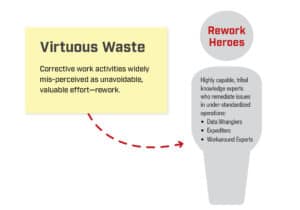
Another reason this wasted effort hides in plain sight: The people doing it do not think of it as waste. They think it is important, necessary, and unavoidable. They think they are helping, and that this effort is simply part of the cost of doing business. It is not. But because they think they are “helping,” The Lab has coined a term for this margin-eroding activity. We call it Virtuous Waste®.
These entrenched mindsets and activities may well represent “the way we have always done things around here.” That does not mean that the old way is the right, or certainly the best, way to do things, and increase scalable capacity in retail operations.
In fact, there are three big assumptions that prevail in retail which, when challenged, open the door to true standardization in retail, and reclaiming earnings of more than 21 percent.
What are the 3 retail assumptions that prevent standardization?
- First retail assumption to challenge: “Our retail business is unique.” Technically that may be true. But carve up your retail ops and you will see that its org structure, activities, systems, and processes are a lot like your peers’.
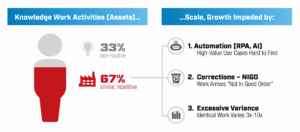
- Second retail assumption to challenge: “You cannot standardize knowledge work, especially in retail!” It is amazing how persistent this belief is, considering how wrong it is. Right now, 67 percent of your retail knowledge workers’ activities are ideal candidates for standardization. That should give you an inkling of the amount of inefficiency that is lurking in your retail business today.
- Third retail assumption to challenge: “New technology will automate retail work.” No, it will not. If you do not standardize first, you will just be trying to automate all of that Virtuous Waste. And guess what? Three-fourths of knowledge-work improvements do not require any new technology at all.
In this long-form explainer article for retail leaders from The Lab, we will tell you about our patented Knowledge Work Standardization methodology, which increases retail productivity by finding and cutting down on Virtuous Waste.
That is not all. It also paves the way for the technologies that will make a difference in your retail operations, including agentic AI, robotic process automation (digital workers), and advanced data intelligence/data analytics/KPI analytics that span everything from sales and performance to inventory management, customers, profitability, and more.
What Is the Definition of Retail Knowledge Work Standardization?
How retailers can take a process-first approach to standardizing
Here is a handy definition for you:
“Knowledge Work Standardization in retail is a process-centric methodology that lets retail executives and their teams to implement process improvement and increase operational excellence and profitability.”
As we had noted above, Knowledge Work Standardization in retail is the path to broader and deeper implementation of agentic AI, robotic process automation or RPA, and KPI analytics, all of which help retail executives with benefits tied to large-scale, enterprise-wide strategic transformation.
When you standardize your retail business, you will keep more margin: up to 2.5 points’ worth. You will increase productivity anywhere from 26 – 41%. And you will increase sales via better market and customer segmentation and marketing.
Learn the basics of Knowledge Work Standardization in this 5-minute YouTube video from The Lab.
The five questions that define end-to-end retail standardization
What to Standardize in Your Retail Operation
Retail transformation requires standardization. But as we had hinted above, you need to know what to ask about standardizing retail ops. This comes down to the following five questions:
Standardizing your retail business, whether it is store-based, digital, or service/experience-based, boils down to not just the workflows. We are talking about the data and activities down at “the ocean floor.” If that suggests a “deep dive” to you, then you are correct.
These are tasks which exist at the 3- to 5-minute activity level. This includes the data these tasks use, including what is input, and what is output. If the process is a molecule, these are the atoms. Thus, you should:
- Map out the tasks to identify all constituent details.
- Measure their work/effort concentration or WEC.
- Map out their to-be state.
Likewise for data:
- You will need to define it.
- You then must source it.
- Finally, you will need to data-model it.
At this point, your data will be ready for automation and your retail business’ to-be state.
Your step-by-step instructions for retail standardization
How to Standardize Your Retail Business
Step 1 for Standardizing Your Retail Business: Map out your current processes. You cannot improve what you have not documented. Here, you will want to create a process map of your existing knowledge-work activities and business workflows.
If this sounds daunting, do not worry: The Lab offers process mapping as a service. We can map your retail ops current state in just 6-8 weeks.
Step 2 for Standardizing Your Retail Business: Classify retail work activities. Make an enterprise-wide system of work-activity classification, also known as a taxonomy. Tag the different activities with 1) volume, 2) performer, and 3) time allotted.
Again, if this sounds daunting, do not worry: The Lab, thanks to our Knowledge Base, has templates to facilitate this step.
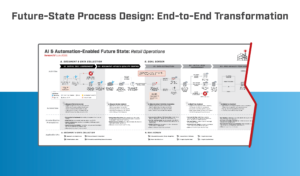
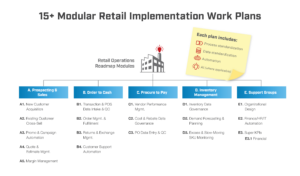 Step 3 for Standardizing Your Retail Business: Map out your to-be retail state. You might think you would use your current-state process map to create your future-state one, but that is actually not the best practice way to proceed. Instead, set your as-is map aside, and draft a bullet list of all the things you would like to accomplish in your retail business’ future state.
Only at that point should you compare this to-be map to what you created in Steps 1 and 2. And then your future-state mapping work is finished.
Step 4 for Standardizing Your Retail Business: List your KPIs for Executives. Define your C-level key performance indicators or KPIs:
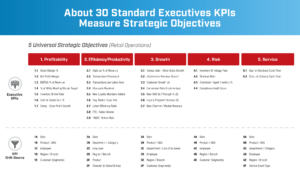
While there are hundreds of KPIs in retail, everything from Average Transaction Value to Net Promoter Score, you will want the “vital few” that are geared toward executives. The ones that provide an at-a-glance “MRI” of the business and its health.
Step 5 for Standardizing Your Retail Business: Trace all data to its source. Every piece of data that is used by your knowledge workers and their systems must begin somewhere. To find this “source of the Nile” in retail operations, you will want to parse each data package to find its parts. Then you will want to find the source of each one, regardless of the system or data warehouse/lake where it resides.
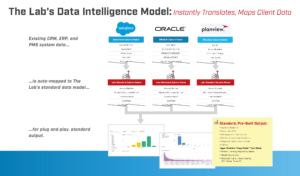
Step 6 for Standardizing Your Retail Business: Standardizing your retail data. Step 5 was all about sourcing the retail data. Now you need to make it standardized. It must be selected, cleaned, and ultimately mapped to the Standard Data Model from The Lab. Now that you have read about The Lab’s Knowledge Base, you are right in guessing that it also contains templates to ease the migration of this data via what is known as ETL, or extract/transform/load.
What retailers gain from standardizing operations and data
The Top Five Benefits of Retail Standardization
Retail executives, internal improvement teams, and business-unit leaders face numerous challenges (not to mention buzzwords) ranging from creating “phygital” experiences to “shoppertainment.” How can standardization in retail help? Consider these top-five benefits which span from the shopper’s experience to your bottom line:
How to get the most value and avoid the false-precision trap
Executive Requirements for Retail Standardization
Standardization in retail requires precision, but only to the level the work actually needs. This tees up what is one of the biggest pitfalls when it comes to retail operations standardization; it is known as the false-precision pitfall or trap.
False precision in retail standardization can be defined as “insisting on getting more information than is actually needed for retail standardization.” It is similar to the issue covered in an article from The Lab concerning process mapping in banks and credit unions: While you must map out your as-is state, you will not map out every single nut and bolt. You will certainly want to find the improvement opportunities, but that does not mean that you must quantify them all.
In retail, this means that you will want to find the upstream problems, to help you identify what you need to standardize… and not “how long each retail process requires” or “how many resources each retail problem consumes.” Those are perfect examples of a false-precision bias in action.
There are a number of things you must do, as a retail executive, to ensure that your standardization initiative delivers the most possible benefits. Specifically, you should…
1. Designate “Standardization” as one of your retail business’ top priorities. This is not a software update. It is a significant operational opportunity, and it should be treated as one.
2. Make “standardization” known across your retail enterprise. Share wins. Make demo videos of things like dashboards and bots. Showcase them on the company intranet. Mention them in emails, town halls, newsletters… every opportunity.
3. Standardize by process and not by business. Follow the process, and the standardization thereof, wherever it takes you. This way, you will not be slowed down by artificial barriers like silos.
4. Select “Standardization Heroes.” Designate champions of process and data: well-regarded peers in your retail organization who can spearhead the initiative and ensure its success.
Standardize your retail business with help from The Lab
Can The Lab Help With Retail Standardization?
The Lab has numerous engagement models which benefit retail leaders including process mapping as a service, retail data standardization, and templatized solutions for retail process improvement, automation, analytics, and agentic AI. Our patented approach supports all levels of existing retail capability, while focusing on standardizing data and processes to accelerate AI and automation implementation. Plus, all of our work features U.S.-based delivery, thanks to our entire team based in Houston, with nothing outsourced or offshored.
Ready to standardize your retail business? To book your screen-sharing demo with The Lab’s experts, simply call (201) 526-1200 or email info@thelabconsulting.com today.