














Standardize Global Payments Operations: Increase Productivity 26% to 41%
Accelerate your adoption of agentic AI, digital workers, and data intelligence into your shared services using the patented Knowledge Work Standardization® methodology
Running a global payments organization requires operational improvement to increase scalable capacity. But as a C-suite executive, business unit leader, or part of an internal excellence team, where do you start? Increasing operating leverage across the secure seven-step cycle of global payments processing (namely initiation, encryption, authorization, response, clearing, settlement, and reconciliation) requires a focus on productivity and, as the title of this article suggests, standardization.
The Lab has spent more than three decades helping business leaders just like you, and capturing that client-engagement IP into our unique Knowledge Base. Working with thousands of organizations over the years, we’ve gained some interesting insights that apply to your shared services organization:
The Problem: Hidden Inefficiencies
Virtuous Waste and Thought-Traps That Limit Performance.
As you read this, your knowledge workforce is spending more than 36% of their day, every day, performing activities such as correcting errors, over-serving customers, or other forms of redundant activity. We call it “Virtuous Waste.”
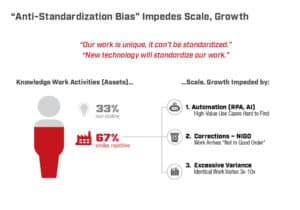
Why “Virtuous”? What could possibly be good about inefficiency in your global payments processing function, where margins are razor thin and you want to speed, not slow, things like settlement times?
This inefficiency provides no business value. But your white-collar workers think it’s good. They believe that this effort is required to provide service to your customers, whether internal or external. They think they’re adding value, not cost, when nothing could be further from the truth.
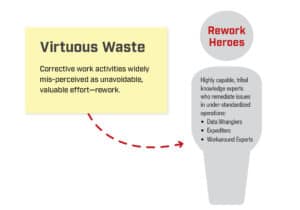
What are the three biggest “thought-traps” that can prevent global payments standardization?
Many global shared services organizations fail to reap the benefits of standardization (which we’ll detail later) because they’re stuck in what we can call “thought-traps.” These are assumptions or notions that workers believe to be true but are not. Here are the three biggest “thought-traps” in global payments; dismantle them and unlock captive earnings of 21% or more:
1. First global payments thought-trap:
“Our way of doing things only applies to our business.” Technically that may be correct, but if you look at other global payments organizations, you will see far more similarities than differences.
2. Second global payments thought-trap:
“There’s no way to standardize what we do.” Knowledge work feels unique, like it’s being created in the minds of your white-collar workforce on the fly. This is a massive misperception; indeed, 66% of knowledge-work activities can be standardized. That’s an indicator of the redundancy and inefficiency they’re currently hiding.
3. Third global payments thought-trap:
“Updating our tech stack will automate everything.” Not so fast. The technology comes after the processes. So if your processes retain that virtuous waste, you will simply introduce virtuous waste into your new technology, not a smart investment. However, three-quarters of knowledge worker improvements don’t require any new technology, either core or ancillary.
The Lab has patented a methodology called Knowledge Work Standardization. It’s been designed and proven to detect and decrease Virtuous Waste. Clearly, then, it allows for process improvement. And it also paves the way for productivity-empowering technologies for global payments such as agentic artificial intelligence (AI); robotic process automation (RPA) and other forms of “digital workers;” and advanced KPI analytics, data intelligence, and automated/proactive reporting. You will learn more about these in this long-form “explainer” article
The Framework: Knowledge Work Standardization
A Process-First Approach to Transformation.
Knowledge Work Standardization in global operations, global shared services, and global payments is defined as “an approach that starts with process and data, and then layers in technology to increase scalable capacity and operating leverage in global shared services organizations.” As we’d noted above, the “technology” here includes AI, automation, and business intelligence/advanced analytics. These combine to provide global payments executives with transformation benefits which span the entire enterprise.
When you standardize your global payments organization, you will preserve more margin, up to 2.6 points. You will be able to boost productivity anywhere from 26% to 41%. With improved market insights, you will be able to grow existing relationships and acquire new clients, whether internally or externally, based on your strategic objectives. Armed with improved customer and market data, your sales team will be better equipped to prospect, up-sell, cross-sell, and close.
Learn more about Knowledge Work Standardization in this classic five-minute video from The Lab.
To maximize the value of your global payments transformation, you will need to standardize it, by asking and answering these five questions:
- When will we be standardizing our global payments operation? Implementation should begin immediately. However, when you take advantage of The Lab’s patented Knowledge Work Standardization methodology, you can standardize global shared services in less than 12 months.
- Where will we be standardizing our global payments operation? You will want to include each system used by your global payments data and wall-to-wall processes, such as payment engines, core banking systems, account management and GL systems, and more, ensuring seamless transactions across banking, mobile, and third-party apps.
- Why will we be standardizing our global payments operation? This is a question you will be asked by management and the rank-and-file. Answer: It’s the proven prerequisite for value-driven transformation.
- What will we be standardizing in our global payments operation? Every process, activity, system, and data, from initiation to settlement and reconciliation.
- Who will we be standardizing in our global payments operation? Everyone; there are no exceptions. You will be standardizing every department and function which is a part of global payments processes and data.
To truly standardize global payments, you need to dive deep within the workflows and discrete data elements that are input, used, and output from them. When you get down to the 3- to 5-minute level of activity detail, you will have reached what’s known as Level 4. These are the components of the process, and not the process itself.
For each foundational activity, you will have to map it down to Level 4 detail. You will need to measure its work-effort concentration, also known as WEC. And you will need to define its to-be state in your standardized global shared services organization.
Ditto for data. For each of those Level 4 activities, you want to find the data, define it, source it, and model it so it’s automation-friendly, and primed for your global payments organization’s to-be state.
Benefits & ROI
Five High-Value Outcomes of Standardization.
From customer-experience lift to improved compliance, there are significant benefits to be gained from standardizing your global payments business:
Benefit 1 from Standardizing Global Payments:
Better compliance, mitigated risk. Once you standardize, automate, and error-proof your global payments processes, you better manage risk (of everything from identity theft to excessive chargebacks) while improving compliance to complex regulations such as AML or anti-money laundering. Standardized processes are replicable and audit-ready.
Benefit 2 from Standardizing Global Payments:
Customer experience lift. Global payments are all about serving customers, at every secure step of the cycle. When you have standardized all processes, activities, and data, then implemented agentic AI and automation, customers experience seamless interactions and transactions, while payment error rates decline significantly.
Benefit 3 from Standardizing Global Payments:
Get more from your team. Improve employee satisfaction, and retention, when all the work they do is perceived as value-add. Your global shared services organization will be the go-to company for the top-tier candidates you desire.
Benefit 4 from Standardizing Global Payments:
More automation. Consider automating more than half of your current-day knowledge-worker global payment activities. It’s possible when you standardize for automation. And the more you automate, the greater the benefits.
Benefit 5 from Standardizing Global Payments:
Conversational data. Voice interaction capabilities extend beyond personal devices to your business data systems. When you standardize global payments operations, you can interact with your data thought natural language interfaces, either via text or even voice. Not only will your questions be answered in plain English, but you will have the assurance that they’re based on the latest “sole source of truth” data.
Success Factors & Pitfalls
Avoiding False Precision and Common Implementation Traps.
A common mental mis-step that catches unwary global payments leaders off-guard is what’s known as the false precision trap. This comes when people demand more data than is needed. It’s a trap that often ensnares global payments executives when they are process mapping their organizations, too: While you certainly want to identify areas for improvement in your wall-to-wall as-is map, you don’t need to chart out the exact benefits of each.
So, consider the parallels when it comes to standardizing global payments, and avoiding the pitfall of false precision. You just want to see where the upstream issues exist, the reasons for wanting to standardize in the first place, and not so much the exact quantification of squandered resources for each. If you head down that path, you may never return. So be sure to push back when you hear calls (as you inevitably will) for unneeded levels of detail.
Implementation Methodology
Six Steps to Standardize Global Payments Operations.
Follow this step-by-step best practice methodology, which has been developed, honed, and proven by The Lab:
How to standardize global payments first step: Map all of your as-is processes. From end-to-end (E2E) and wall-to-wall, you will want to visually chart each global payment business process and workflow. The Lab offers process mapping (including improvement identification and best practice up-level inventory) as a service; we can map out your E2E global operations in just 6-8 weeks.
How to standardize global payments second step: Tag your workflows. You will need to create an organization-wide taxonomy or categorization of all enterprise global shared services activities, including volumes, roles (who does what), and time allowance for each. The Lab’s Knowledge Base includes templates to facilitate this step.
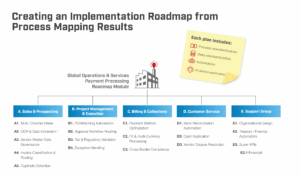
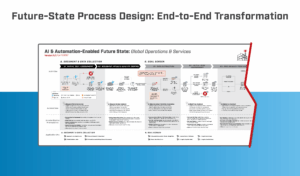
How to standardize global payments third step: Map the to-be state. Envision this as your ideal future state for how the global payments organization should operate. Set aside the as-is map you have just created; design the future-state map without letting current constraints influence your vision. Afterward, compare it to your Step 1 and Step 2 outputs.
How to standardize global payments fourth step: List your KPIs. To gauge your global shared services’ health from an executive level, you will need to define your Executive KPIs (key performance indicators).
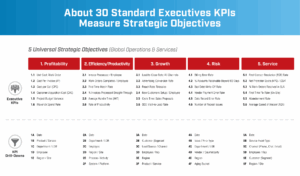
The Lab offers comprehensive catalogs of KPIs which span many of the industries which your global payments organization may serve.
How to standardize global payments fifth step: Trace the data to its source. Data in global payments spans lots of payment processing and operational platforms, used to
calculate interest, ensure compliance, provide connectivity to global payment networks, and deliver seamless transactions. So, in Step 5, you need to track each element back to its multiple sources, across all systems and platforms. This involves identifying the origin point for each data component.
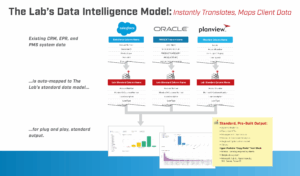
How to standardize global payments sixth step: Apply data standards. After the fifth step of tracing the data, you will need to standardize it. How? The Lab’s templates will help as you map the data to our Standard Data Model via extract/transform/load, commonly known as “ETL.”
Executive Priorities
Three Guidelines for Maximum Transformation Value.
When it comes to standardizing your global payments operation and improving KPIs ranging from cost per transaction to invoice processing time, executives should follow these three guidelines for maximum benefits and value:
1. Don’t prioritize by business. Prioritize by process. Follow processes to standardize wherever they may take you. Don’t let your transformation get stalled by artificial boundaries or internal silos.
2. Assign your Executive Process Committee. Gather your most respected peers to spearhead the transformation effort and act as its champions, guiding it to success.
3. Give “Transformation” the priority it deserves. Transforming your global payments organization should be one of only three top strategic priorities for the enterprise. Make its impact known. Celebrate wins, with town halls, newsletters, CEO emails, and demonstration videos of standardization-powered automations, which you can post on the company intranet.
Getting Started
Partnership Options and Next Steps.
The Lab offers global payments executives, business unit and technology leads, and internal improvement teams numerous ways to transform, including process mapping, data standardization, and proven templatized solutions for process improvement, digital workforce/automation, data analytics, and agentic AI. Our patented Knowledge Work Standardization methodology improves all levels of existing capability. Our entire team is based in Houston, with nothing outsourced or offshored, ever.
Ready to standardize your global shared operations? To book your screen-sharing demo with The Lab’s experts, simply call (201) 526-1200 or email info@thelabconsulting.com today.