













Increase Your Public Utility’s Productivity by 26-41% with Knowledge Work Standardization®
Accelerate your adoption of agentic AI, data intelligence, and automation to improve efficiency, safety, and compliance in your public utility
Operational improvement is top-of-mind for any utility executive, whether that utility provides water/sewage, electricity, and/or gas. It does not matter if you head up a municipal-run utility, a community co-op, or an investor-owned utility.
And if you are a business-unit or technology leader, or even part of an internal improvement team, the strategic transformation objective of operational improvement is pressing, amid the challenges of aging infrastructure and an aging workforce, surging demand, decarbonization mandates, and high-capital costs, among others.
If operational improvement is the goal, where are the opportunities to be found within your utility? Are they scattered? Concentrated in certain areas or operations?
For more than 30 years, The Lab has been building our Knowledge Base of actual client-engagement IP, we have found that, all too frequently, the bulk of utility operational improvement opportunities are hiding in plain sight.
Your utility’s knowledge workers, a.k.a. your white-collar workers, are spending upward of 35% of their workdays, every day, on what we at The Lab have named “virtuous waste®”.
This should make you ask a few things. What is this “virtuous waste”? Where is it hiding? What is so “virtuous” about it? And what can you do about it, to boost your utility operation’s efficiency and productivity?
Where the wasted effort is hiding in your public utility
What Is Virtuous Waste of Knowledge Work in Utility Operations
White-collar virtuous waste in public utilities refers to 1) fixing errors or mistakes, 2) redundant effort, and 3) superfluous over-serving of your utility’s customers: that is, providing extra service that they do not need or pay for.
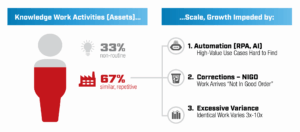
But what is so “virtuous” about it? Here is the answer: All those utility knowledge workers, doing all of what is clearly (to you, at least) wasted effort, believe they are doing the exact opposite. They believe that this effort cannot be avoided. They think it is essential for serving your rate-paying customers. They believe it is simply a cost of doing business, if they even think of it as a “cost” at all.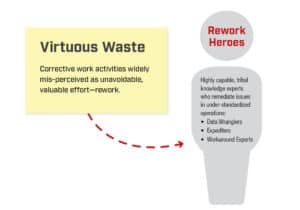
These workers, doing these things this way, have been doing them this way forever. However, that does not mean it is best practice in utilities. Virtuous waste is rooted in three core beliefs that pervade the industry; challenge them, and you are on your way to standardizing your utility, and re-claiming earnings north of 20%. Here are the three beliefs:
- Utility “Virtuous Waste” Belief 1: Our utility company is unique. Your knowledge workers may think your company is unique in terms of its geography, customer base, infrastructure, challenges, or ways of getting things done. Utilities are by and large far more similar than different, and this drills down quickly to essential activities, org structure, and processes. There is best practice out there, and it does not include virtuous waste.
- Utility “Virtuous Waste” Belief 2: You cannot standardize our utility knowledge work. Not only is this belief incorrect; it is measurably incorrect. The Lab’s experience has proven that more than 2/3 of your utility’s knowledge-work activities are ideal candidates for standardization. You will learn more as you progress through this article.
- Utility “Virtuous Waste” Belief 3: New technology and AI will automate our utility’s knowledge work. This is another flawed assumption that we see amid the ranks of utility knowledge workers all the time. Unless you first eliminate all the virtuous waste we described above, no technology or AI will fix your operations. You will simply automate a mess or move bad practice from an older system to a newer one. Note that three-quarters of all knowledge work improvements require no new core technology.
This long-form explainer article for utility executives, technology leaders, and internal improvement teams will teach you about the patented Knowledge Work Standardization approach from The Lab. You will see how it uncovers and pares back virtuous waste, while increasing productivity across your utility’s operations. And it allows for faster adoption of technologies like AI, digital workforce (robotic process automation in utilities), and advanced business intelligence and data analytics, with strong ROI.
Putting process before technology in your public utility to uncover & implement improvements
What Is the Definition of Knowledge Work Standardization in Utility Operations?
The definition of Knowledge Work Standardization in utilities is:
“Taking an approach that begins with the process and centers on standardization, along with the latest technology, for executive-led enterprise-wide improvement across utility operations.”
Knowledge Work Standardization does more than help you to rapidly onboard technology like AI, automation (digital workers or “bots”), and advanced analytics. It also equips utility executives to realize large-scale transformation and process benefits across the entire operation.
Standardization in your utility lets you:
- Retain more margin: Up to 2.6 points.
- Boost productiveness: Reduce waste. Recoup gains from 26% to 41%.
- Increase regulatory compliance: Standardization optimizes your audit trail, while improving customer satisfaction (CSAT) rates.
Want to learn more about Knowledge Work Standardization? Check out The Lab’s informative 5-minute overview video.
What to avoid, what to ask, and how deep to standardize
What Questions Should You Ask When Standardizing Your Utility?
As you look to standardize your electric power utility, water & sewer utility, and/or natural gas utility, you will want to avoid a classic pitfall known as “false precision.” This is a trap that is easy to fall into; it is about demanding more data than you need.
For a quick analogy, check out this article from The Lab about process mapping in banks and credit unions. It shows that while you want to map your as-is state, you do not need the “false precision” of too much information. Your goal is to uncover opportunities for improvement, not to quantify them all.
A similar challenge exists when it comes to standardized public utility operations. Uncover the issues to help you see what needs standardizing. Do not insist on the “false precision” of how long a given process requires, or the exact quantity of resources it consumes.
Transforming your public utility requires standardization. It is the essential prerequisite. To help you get started, evaluate the following five questions:
- What within our utility should be standardized? You will be looking to standardize all data and processes (such as meter-to-cash and more) from one end of the enterprise to the other.
- Who within our utility should be standardized? Utility standardization affects every department that its processes traverse.
- Where within our utility should we standardize? Now, you should see the pattern: This affects every system that the data and processes employ.
- Why should we standardize our utility? Standardization delivers the highest value per unit of effort, accelerates transformation, and produces the widest range of benefits.
- When should our utility begin its standardization initiative? Short answer: ASAP. Fortunately, the patented Knowledge Work Standardization® approach from The Lab allows for public utility standardization in only 6 months to a year.
In order to standardize your utility, you will want to address work-flows and data “down to the ocean floor.” Often referred to as “Level 4 Activities & Data,” this describes tasks that exist at the 3-5 minute activity level. And it refers to the data that these processes use and change. Therefore:
- For the “ocean floor” utility activities, you will need to map them to grasp them in detail. You will want to document what is known as their WEC, or work/effort concentration. And you will want to understand their to-be state.
- For the “ocean floor” utility data, you will need to provide definitions, locate sources, and create data models, to not just standardize it, but also ready it for future-state automation and AI in utilities.
C-suite enterprise benefits of standardizing utility data and processes
What Are the Benefits of Public Utility Standardization?
From increased usage of AI and automation through improved customer experience, there are many benefits to be gained by standardizing your public utility’s business processes and data:
The most important steps for standardizing a public utility (in order)
Where Can I Find a Simple Step-by-Step Guide to Utility Standardization?
There is a best-practice order when it comes to standardizing your municipally-owned, co-op, or investor-owned public utility. Follow these six steps:
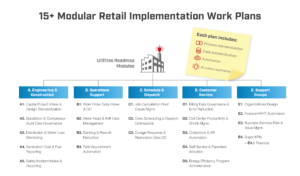
- Create a current-state process map of your utility. Map out all end-to-end or E2E business processes, knowledge work tasks, customer journeys, and the resulting improvement opportunities, based on best practice. While this step may sound daunting, know that The Lab offers E2E process mapping as a service, and can do all this work for you, in only 6-8 weeks.
- Classify your utility’s activities. You will need to create a classification system (a.k.a. taxonomy) of your utility’s knowledge-work activities. Each needs to be tagged with 1) volume of effort, 2) person performing the work, and 3) amount of time needed to perform that activity. Again, this step seems daunting; again, The Lab can simplify this step for you, with templates from our IP Knowledge Base.
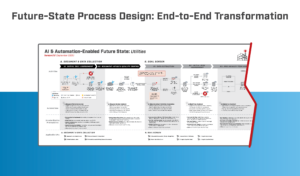
- Map out the to-be state of your public utility. Create your future-state map while, counterintuitively, paying no heed to your current state. Just make a “wish list” of what you would like to see happen in your utility. After you have done that, take what you have created from the first two steps, and compare it to your future-state map. The resulting comparison will complete this step.
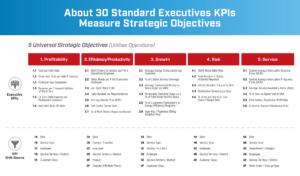
- Create your list of Utility C-Suite KPIs. You and your fellow executives will need to be kept apprised of your utility’s health at a glance; this is where KPI (key performance indicator) dashboards are essential. So, you will need to define your C-Suite/Executive-Level KPIs. These will span the broad topics of system reliability and safety; operational and asset efficiency; and customer service/billing. The Lab offers Executive KPI analytics and data intelligence as one of our core capability offerings. With our pre-built, templatized tables, AI models, and utility-specific KPIs, we can help you complete this step toward utility standardization.
- Trace utility data back to its sources. Track all the data you use back to its sources. This can be systems such as your customer information system or CIS; your geographic information system or GIS; your utility’s enterprise asset management (EAM) platform; its supervisory control and data acquisition (SCADA) platform; its advanced distribution management system (ADMS); outage management system (OMS); advanced metering infrastructure (AMI) system; meter data-management system (MDMS); enterprise resource planning (ERP) platform; and others. And it is not just those systems. It is also where the data resides, in places like your enterprise data warehouse or lake. And do not forget all those daily systems, such as HRIS, SharePoint, and others.
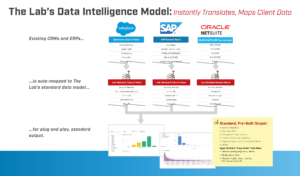
- Unify the utility data via standardizing. Take the data from Step 5, and then ETL or extract/transform/load, it to The Lab’s Standard Data Model, which normalizes all the information into a structured, semantic database. The Lab’s templates speed this process for you.
How can public utility C-suite leaders guarantee the most benefits from standardization?
What Is the Utility Executive Sponsor’s Role in Standardization
As a C-suite executive of your public utility, you want to ensure that your standardization initiative delivers the most possible value. Here are three best-practice guidelines to make sure that your leaders and teams stay on track:
- Select your Standardization Team. These are respected leaders/process champions/tribunals who will take ownership of the effort and lead from the front.
- Standardize by process, not by line of business. Do not let silos, rice bowls, or even established organizational barriers stand in the way of your standardization effort. Standardize the processes… wherever they lead you.
- Keep “Standardization” front-and-center for the enterprise. Use your influence as an executive to your advantage. Make standardization a top-three enterprise priority. Update the organization in town halls, newsletters, and emails from the CEO. Share early and ongoing wins. Create and promote videos of standardization in action, e.g., with standardization-enabled automations performing the least popular activities in the organization.
Start standardizing your public utility with The Lab
Can The Lab Help to Standardize Your Public Utility?
The Lab provides numerous engagement models to help public utilities, including process mapping, data standardization, and templatized, modular solutions for process improvement, automation, analytics, and AI. The Lab’s patented approach and methodology improve all levels of existing capability, with a focus on standardizing data and processes to accelerate AI and automation implementation. All work is performed by our Houston-based team, with nothing outsourced or offshored, ever.
If you are ready to standardize your utility, book your screen-sharing demo with the experts from The Lab. Simply call (201) 526-1200 or email info@thelabconsulting.com today.