














How to apply Knowledge Work Transformation™ to your Global Payments Operation
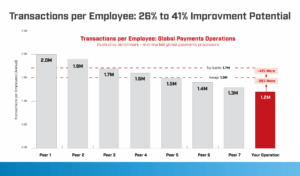
Transform your payments function & see productivity growth of 26% to 41%
The Transformation Imperative for Global Payments
From process mapping to AI-enabled payments operations.
If, as a C-suite executive, transformation or business-unit lead, or part of an internal improvement team, you’re committed to transforming your enterprise’s global shared services and payments function, you’ve come to the right article from The Lab.
Your transformation goals could include an accelerated path toward real-time/instant payments, onboarding advanced biometric security, contactless payments, stablecoin adoption, multi-rail payments driven by APIs, and more.
The essential prerequisite to transformation of your payments function is process-mapping. (The Lab, incidentally, offers process mapping and business improvement as a service.) All current-state, end-to-end or E2E processes should be mapped down to the three- to five-minute level of activity detail. This detailed mapping serves as the foundation of your payments function’s transformation.
What should you do after creating the as-is process map of your global payments function?
This article assumes that you’ve completed current-state mapping and gained a strong understanding of your payments operation. The transformation will be comprehensive, including:
- Business process standardization
- Onboarding digital workers/automation
- Employing agentic AI
- Data cleanup and standardization to empower executive KPI analytics
But first, let’s explore some of the challenges that await your transformation initiative in your payments function.
Three Critical Transformation Challenges
Common obstacles and how to overcome them.
Many payments and global-shared-services leaders have tried to transform their organizations before, only to have been met with less-than-stellar results. Setbacks are common. Over-investing in project management and/or task engineering often yields only theoretical benefits.
But if you know the three main challenges of global payments function transformation in advance, your odds of success already begin to increase:
Challenge 1 for Global Payments & Shared Services Transformation: Where do you start?
As mentioned, the key to starting is process mapping. This eliminates the opacity that may be blocking your view, as an executive, into the daily operations of your payments function. Process mapping should always be your starting point.
Current-state process mapping of your payments function will reveal:
- What is happening deep within the organization
- What is currently working
- What is currently broken
- What’s required for improvement
Your first challenge for transforming your payments function is also your first step toward actually performing the transformation.
Challenge 2 for Global Payments & Shared Services Transformation: Improvement priorities
Once you’ve completed process mapping of your global payments function, you’ll have a substantial list of available improvements that could be implemented, ranging from simple to complex.
The improvements could be as simple as creating new to-do lists for daily activities. Or they could be more sophisticated, using, for example, agentic AI to trigger downstream “bots” or automations (robotic process automation a.k.a. RPA) that actually do the heavy lifting within your core and ancillary systems, payment gateways, and more.
This large list of improvements can be overwhelming, since all are competing for urgency. But the answer is simple: Start at the start. Every process begins with input; start there. As you can likely imagine, improvements which you implement upstream, deliver outsized benefits downstream.
The opportunities reside at every point of the secure seven-step payment-processing cycle, including initiation, encryption/transmission, authorization request, authorization or decline, response relay, clearing, and settlement. When you’ve properly standardized the data and processes, you can:
- Shift from simply moving money to providing integrated intelligent financial experiences.
- Reduce friction for customers across the payment processing cycle.
- Cut down on rework by 26 to 41 percent.
- Increase scalable capacity by enabling follow-on automations which increase operating leverage.
So “starting at the start” is not only powerful. It’s repeatable. Use it to proceed across all processes and business units.
Challenge 3 for Global Payments & Shared Services Transformation: Resource constraints
Many global payments leaders assume that they’ll need to shut down their operation in order to introduce the improvements—an impossible ask.
Fortunately, this isn’t required. The Lab has helped to transform businesses across a variety of verticals for more than three decades; never have we forced them to hang a “Closed” sign on their door. To the contrary: The businesses keep on humming along while the transformation is underway.
The secret resides in The Lab’s Knowledge Base, which has captured all client-engagement IP from the very beginning. This semantically structured repository gives you the templates you need to accelerate global-payments transformation, including:
- Process maps
- Best practices
- Agentic AI and automation use cases
- Bot code
- More
With this drag and drop ability, you’ll basically select from a menu, and see the improvements—and benefits—in your payments function implemented at 4x the speed of what you’d accomplish without the templates. And remember: Per Challenge 1, you’ll always “start at the start” of any given process, ensuring that you reap the maximum value from transforming it. This will free up more resources to enable even more improvements and transformation. It snowballs.
Not that this is easy. It’s not. It takes work. But with a clear path forward, your priorities in line, and The Lab’s templates in hand, you’ll succeed where you may have failed before, and start realizing measurable benefits in the shortest possible time.
Three Primary Sources of Transformation Value
Where measurable benefits originate in global payments.
You know, as a shared-services/payments-function leader, that transforming operational performance helps you navigate headwinds such as security and fraud risks, ever increasing costs and fees, regulatory compliance, chargeback management, delayed settlement times, and more.
What, then, are the top three sources of benefits of Knowledge Work Transformation™ in global payments? With The Lab as your partner, you can start seeing these, in as little as 6 – 12 months; note that we’ll dive deeper into the downstream benefits themselves, later in this article. In the meantime, here are the three sources you’ll want to focus on:
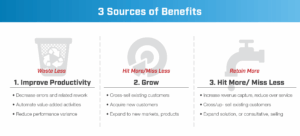
Payments Function Benefit Source 1: Reduced waste.
Imagine your team performing the same payments-processing functions that they do today… with fewer steps. Transformation-enabling improvements will change the order and organization of the tasks which comprise daily activities, sometimes even eliminating redundant steps; of course, this is helped along by standardization of processes and data, as well as technologies such as agentic AI and digital workers/automation/RPA.
The upside is significant: 26% to 41% improvement in organizational capacity—and more scalable than ever. Reduced wasted effort also delivers reduced errors. That, in turn, leads to improved regulatory compliance and an elevated customer experience at every touchpoint.
Payments Function Benefit Source 2: Increased sales.
Transformation of your global operation delivers the most basic of benefits: More revenue. Automation and KPI analytics can help managers and staff with things like new models of customer segments; heightened opportunities for upsell/cross-sell; and customer/market data that can be leveraged in daily activities, not just sales and marketing.
Payments Function Benefit Source 3: Reduced revenue leakage. No payments-function leader wants to see margin slip away. When you transform your shared services knowledge work activities and data, you effectively get to keep more margin. How? See actual margin, in real time. Segment it by product. By service. By customer. By industry. Price new deals with newfound precision. Taken together, you can add measurable margin increases to your operation.
Your Strategic Transformation Framework
Four essential questions every payments leader must answer.
The Lab’s patented transformation methodology has been helping business leaders just like you since 1993. We’ve arrived at that best-practice approach methodically over the years; if you, too, would like to move the KPI needle and boost margin in under a year, ask—and answer—these questions, which will form the next sections of this article:
1. Where should I start my payment function’s transformation?
2. What in my shared services/global payments function should I be transforming?
3. How can I ensure that my global payments operation attains measurable value from its transformation?
4. What are the most common pitfalls to avoid during my global payments business transformation?
Implementation Roadmap: Where to Start
Four-step process for launching your payment transformation.
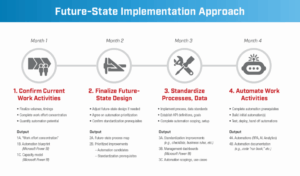
There are four steps to this “where to start” question.
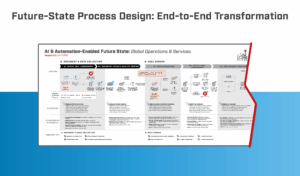
First step: Create a payments function to-be map of processes.
Naturally you’ll want to map out the future-state of your payments function’s processes. But counterintuitively, don’t concern yourself with the “how” just yet. Simply map out what you’d like to see accomplished.
Next, you’ll identify the gaps between the future and the current state. How? Use a best-practice inventory—The Lab provides this as part of our process-mapping service. You’ll quickly see which tasks need to be standardized, automated, and even eliminated.
The Lab also offers pre-built future-state process maps which are readily deployed at your payments processing operation.
Second step: List what needs to be done to close the current/future gaps.
To perform gap testing between your as-is and to-be states, list all of the prerequisites:
- Payments function activities that are being performed
- The various tools and systems that are being used to perform them
- The different rules and policies which apply
- How the work is organized, i.e., what is done and by whom
- The engineering that will be needed to accommodate the to-be automation
Here are some of the things you’ll want to collect as part of this step:
- Standardized document inventory
- Standardized repositories and data tables for the info you’ll collect
- Standard file-name conventions, standard templates, and standard methods for triage
Third step: Apply a Standard Model to your payments function data.
After you’ve identified the vital few Executive KPIs for your future-state global payments operation, list out the data required for advanced analytics and automation, including sources, fields, and tags. Then implement the standard data model, using the template available from The Lab.
Want to see advanced data intelligence in action? Check out these videos from The Lab:
- Inventory Management AI & Data Analytics: Distributors & Manufacturers, Executive KPIs & Automation 4.5-minute video.
- Wholesale Distribution Executive KPIs: AI + Automated Data Standardization, Reporting & Improvement 4-minute video.
You can see even more at this playlist on The Lab’s YouTube channel.
Fourth step: Locate the appropriate support and resources.
Now that you have your requirements list in-hand, you may be surprised to learn what you won’t need, as much as what you will, to create your go-forward work plan. Let’s start with the latter:
- You’ll need transformation champions. These are the valued subject-matter experts who will spearhead the transformation in the different areas of your global payments function. Make a list of them, and their counterparts in IT. Add other peripheral functions only as needed; you want to avoid over-engineering this process with redundant checks and approvals.
- You won’t need new systems. You might think that “transformation” of your shared services operation implies—indeed requires—a wholesale replacement of your core, ancillary, and payment processing systems. Untrue. Automation/digital workers, paired with AI, effectively reside atop your existing systems. Think of them as an enhanced front end for your extant platforms. They help them do what they’re already good at… and more. So you don’t need new systems. And you don’t need to allocate budget toward them, either.
Transformation Scope and Focus Areas
What to transform in your shared services operation.
We can list three strategic areas to transform:
- Increased automation. Nothing multiplies your operating leverage like well-planned and implemented automation. It also makes people’s days easier.
- Standardized business processes. Each one needs to be scrutinized and analyzed to pare them down to their essentials—while adding consistency.
- Improved KPIs for executives. Executive KPIs, unlike management KPIs, are the 30,000-foot vital few which give you an at-a-glance health report of your global payments operation, handing you visualized data which empowers better strategic decision-making.
These include payments KPIs such as Authorization Rate, Chargeback Ratio, Decline Rate, Transaction Cost, Payment Conversion Rate, and System Uptime; as well as AP (Accounts Payable) KPIs such as Invoice Processing Time, Payment Error Rate, and more.
(Don’t worry: Your transformation will include management-level KPI analytics, too.)
Despite recent advances in systems used by global payments functions—including core banking systems, payment gateways, GLs, and digital cores—the truth is that people are often required to “glue” different systems together, because the systems can’t talk to each other, otherwise. This is why typical process-improving initiatives fail to deliver significant efficiency.
But when you layer in the automation, standardized business processes, and KPI analytics noted above, you can truly transform your shared-services function. This requires that you first map out a future-state E2E (end-to-end) process for each function; list out its requirements; and standardize the data for automation.
Executive leadership requirements for transformation ROI.
Simply “starting at the start” and arming yourself with current and future-state process maps is insufficient for achieving measurable benefits from your global payments function transformation. You will also need:
- Executives who stay ahead of the updates. Certainly, your global payments function transformation will require executive sponsorship. But how do you stay ahead of updates?
As an executive sponsor, you’ll need to participate in the monthly update meetings—and not the in-the-weeds work-group sessions. But you’ll also want to arrive at the monthly updates armed with information that empowers you to be proactive
This is actually easier than it sounds. When you engage with The Lab, we provide previews to executive sponsors, for this very reason.
We report to your company from the top down. So you’ll get executive-level highlights, quickly, with enough details to let you lead, rather than reacting to an update in the update meeting. It also lets you head off any pushback, pre-emptively. You’ll be able to focus your time and effort on keeping the organization aware of, and aligned with, the transformation goals.
- A comprehensive budget. You’ll need to arrange your global-payments-transformation spending according to the processes, automation, and KPIs that are being transformed. Don’t arrange it by business area.
When you budget by process, you can sail past artificial borders, ensuring that the transformation positively impacts the entire organization.
- Top-down communication. As an executive, you’ll want to take advantage of your “mountain top” to socialize wins across the entire global payments organization.
Make internal marketing videos, with demos of bot prototypes and KPI analytics dashboards. Highlight how the most common pain-points are being eliminated. This is exciting work! So make sure that the excitement is contagious.
Keep the momentum going amid all your communication opportunities:
- Organizational town hall meetings. In your quarterly town-hall meetings, allot about 15 minutes to the transformation effort. Let your champions take center stage and share their early wins. Use those videos. Post them on your intranet. And always showcase them in the context of the larger strategic goals which underpin your global payments function’s transformation effort.
- Company newsletters. Make sure the transformation is front-and-center. Keep the news letters terse, so they’re actually read. Provide generous kudos to the people making it happen.
- Emails from the CEO. Whenever the transformation reaches a pre-set milestone, send out an executive-sponsor congratulatory email, directly from the CEO, to the whole organization. This helps to keep the momentum going, while proactively heading off any possible pushback or inertia.
What to do and what to avoid for transformation success.
When you’re looking to transform your global shared service operations, you’ll want to avoid the common pitfall of putting technology before process. Don’t over-engineer the effort. Keep the pace brisk. Keep the approach agile. Aim for a lather, rinse, and repeat style of implementation.
So avoid the temptation to add too many layers, too many reviews, too many people. Keep it lean.
Five Transformational Benefits for Global Payments
From employee empowerment to customer experience elevation.
Partner with The Lab for Accelerated Results
Transform your global payments function with proven methodology.
For over three decades, The Lab has helped C-suite executives, business unit leads, and internal improvement teams with large-scale transformations which deliver measurable results and benefits. Our unique Knowledge Base, containing more than 30 years’ worth of templatized, re-deployable client-engagement IP, paired with our proprietary, patented Knowledge Work Standardization® approach—can help to transform your organization in just 6 to 12 months.
Ready to transform your shared-services operation? Book your demo today by contacting the friendly experts at The Lab at (201) 526-1200 or via email at info@thelabconsulting.com.