















Global Payments Process Mapping: A How-To Explainer Article
Discover how to map every activity, from initiation through reconciliation, in just six to eight weeks
Why Process-Map Global Payments Now
The external forces driving process mapping to the top of your strategic agenda.
Global payments processing has become more difficult: more regulators, more rails, tighter margins, and customers who expect everything in real-time. These include elevating security with AI and biometrics, embedding buy-now/pay-later services, keeping ahead of security and fraud risks, regulatory compliance, and more.
If you’re looking to increase operational efficiency and operating leverage—a safe assumption—the first step on your strategic transformation roadmap should be mapping every process in your shared-services operation. This wall-to-wall, end-to-end process map of your current state is the key to unlocking the most value in your intended future state. And that includes all of the must-have technologies such as agentic AI, an automated digital workforce, and KPI analytics in real-time.
Whether you’re a C-suite executive, technology or business-unit lead, or part of an internal operational improvement team, this long-form “explainer”-style article from The Lab will help you learn how you can actually achieve end-to-end or “E2E” process mapping in as little as six to eight weeks.
You know the challenges that your global payments operation faces; consider the security and fraud risks alone:
- Account takeovers
- CNP (card-not-present) fraud
- Identity theft
Now add in challenges like rising transaction fees, technology that’s fragmented across new and legacy systems, and the glaring operational inefficiencies from stubborn manual processes and data entry, and you can see why process mapping is needed, “upstream,” to get a handle on your payment-processing function prior to any transformation.
You also want to improve KPIs—such as Chargeback Rate and Cost Per Transaction—across all phases of the secure payment-processing cycle of initiation, encryption, authorization, response, clearing, settlement, and reconciliation. And this is amid changes in core and peripheral platforms (which don’t speak to each other!), M&A activity, and more.
Clearly, process-mapping your global payments function is your strategic prerequisite.
What resources are available for process mapping in global payments?
As you seek to grow margin, while serving your customers better, you want to find and leverage every opportunity for operational improvement which process mapping in global payments can unlock for you.
External resources such as The Lab can prove invaluable. Our patented approach puts process before technology. This means that you can layer new technologies, such as agentic AI, atop your existing systems, without replacing any of them. You can keep all of your systems intact, including:
- Primary back-end core banking platforms
- POS and payment gateways
- Account management and GL systems
- Cloud-based and API-driven cores
This article will show you how The Lab can help you to process-map your global operations in as little as 6 to 8 weeks, ultimately paving the way for speedier invoice processing time, reduced payment error rates, and more.
In-House, External, or Hybrid: Choosing Your Process-Mapping Approach
When internal teams can handle it, when to bring in a partner, and what each path delivers
Your process-mapping effort—whether you do it in-house or with the help of a partner like The Lab—will allow you to study, visualize, and analyze your current-state processes in global payments. You’ll uncover opportunities for improvement. You’ll be able to cut redundancy, improve and monitor operational KPIs, and find new places for AI and automation.
This clears the path toward an improved to-be operation, in which costs are reduced, tech-stack value is maximized, customer experience is elevated, and overall enterprise value improves.
This step-by-step explainer article will teach you how to process-map your global payments function. You’ll learn which tools will serve you best, and which common errors you can avoid. You’ll see how you can cut down on things like pricing overrides, while boosting payment-processing and accounts-payable KPIs, in less than a year.
The Lab has been helping operational leaders for over 30 years. In fact, during that time, we’ve captured and organized all of our client engagement IP into our Knowledge Base and templatized it for rapid and cost-effective transfer to your business.
What Process Mapping Actually Is
A working definition, plus the three-phase lifecycle from strategy through implementation.
Process mapping for shared services such as global payments is defined as the visual representation of workflows, from end to end, spanning all phases of payment processing including initiation, encryption, authorization, response, clearing, settlement, and reconciliation (depending upon the phases your organization handles). As the name implies, the actual deliverable looks like a flowchart or map.
A good process map for global payments is easy to read and understand. It breaks down complicated activities into simpler tasks. By heightening transparency, it reveals what can be improved.
The actual drafting of process maps can be completed, as we’d mentioned earlier, in just six to eight weeks. But that’s with the help of templates from The Lab’s Knowledge Base; furthermore, the prep for that six- to eight-week phase can take much longer.
Here, then, are the three steps for process mapping your global shared services operation:
First step for global payments process mapping: Strategy
This step typically takes anywhere from 3 months to 1.5 years for global payments leaders and their teams to perform. It includes:
- Pinpointing an org-wide issue which needs fixing
- Identifying a C-suite project-mapping sponsor
- Listing the goals of the project map initiative
- Scoping a cross-functional, benefit-focused objectives
- Winning buy-in at the org and department levels
Second step for global payments process mapping: Map drafting/review
The Lab can help your shared operations to perform all of the following in just six to eight weeks:
- Wrangling existing procedures and SOPs, regardless of condition
- Listing all global payments systems
- Cataloging the data types for each platform
- Interviewing subject-matter experts
- Drafting a visual map, showing 1-5 minute detail of activity
- Conducting a Map Fair to get feedback and improvements
- Identifying and classifying all identified potential future-state improvements
- Writing up the business case for the transformation plan
Third step for global payments process mapping: Improvements implementation
The following often requires three to twelve months:
- Forming implementation & support teams
- Standardizing business processes
- Paring “NIGO” (not in good order) activities
- Cleaning the data
- Layering in Agentic AI, RPA (robotic process automation), and advanced analytics reporting
- Implementing executive and management KPIs to sustain momentum
How to select the best process mapping consultancy for global operations
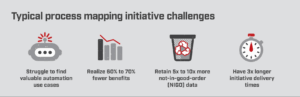
The Lab has refined our process-mapping methodology over more than three decades. This experience has produced a proven approach. Among its advantages:
- It’s faster. The Lab not only does the heavy lifting; we also make it easier on your global payments subject matter experts, who will only need about an hour a week of their time to contribute, over about 6-8 weeks.
- It builds a bigger, better benefits case. Your global payments process mapping deliverables from The Lab includes capacity requirements for every process and department, making a straightforward benefits case for implementing improvements.
- It uncovers more improvements. Process maps from The Lab are annotated to include every opportunity for adding agentic AI, automation, better controls, and the elimination of that insidious NIGO or not-in-good-order rework which contributes to wasted effort and costs downstream. All of this is documented down to the specific one- to five-minute activity level, from wall-to-wall in your global payments processing organization.
- Best-practice benchmarking, baked in. The Lab will not only process-map your shared services’ activities; we’ll also compare them to peer best practices. This hands you the opportunity of closing competitive gaps in a more effective to-be operational state.
Are external consultants required for global shared services process mapping?
When a truly transformative change affects payment processors, such as during a merger, acquisition, or while onboarding a new core system, the largest ones in the U.S. often rely on external firms for their process mapping. In addition to the disruption from the big changes, they simply lack devoted internal teams for wall-to-wall current-state mapping.
It’s not just the very largest global payments operations that seek outside help; many mid-sized organizations do, too.
Can anyone in my global payments operation perform process mapping?
If you’ve got an established process-improvement team in place in your global shared services operation, such as those with Lean Six Sigma Black Belts, then you likely have people on-hand who can help with your process mapping.
Look for titles such as “Business Analyst” or perhaps “Engineer of Processes.” If you already have data scientists on staff, look for those with process experience; they can be a great asset.
Note that it’s the process-first people you want to recruit, as opposed to those in IT.
Which external firms offer process mapping for global payments processing functions?
When you are time- and resource-constrained, nothing beats the help of an external partner when it comes to process-mapping your global shared services organization. The Lab offers process mapping as a service; as you can guess, it’s typically much faster, and more comprehensive, than what you could do with internal resources.
When you engage with The Lab for process mapping of your global payments organization, we run the project. Of course, we draft the detailed maps. And we use teaching methodology that we’ve developed over literally 100’shundreds of client engagements; it’s part of our patented Knowledge Work Standardization® delivery methodology.
It’s also captured in our Knowledge Base, with more than 30 years’ worth of client-engagement IP in a semantic structure that includes not just process maps, but best practices, KPI dashboards, and even automation code.
Tools and Scope: Setting Up the Project for Success
Software options, systems coverage, and the four best practices that keep mapping initiatives on track
Fortunately, your global payments organization has lots of options when it comes to the actual tools you’ll use to create your process maps:
- IBM Blueworks. A cloud-based process-mapping option unique to IBM’s platform.
- Microsoft Visio. This is the most popular software for process mapping, and has been for years. It’s readily available, and easy to install.
- Signavio. Visio and Blueworks aren’t the only games in town; there are other cloud-based alternatives that compete, including Miro, Lucidchart, Miro, and Diagrams.net
All of the above are software. But there’s old-school “hardware,” too:
- Brown butcher paper. Available in big rolls, they’re easy to mount on a wall and festoon with sticky notes. This can be a perfectly suitable choice for process mapping your global operations.
- Whiteboard. The same one you use in group meetings for fast, Pictionary-like rendering of ideas can also be employed for rapid mapping and visualization of your shared services’ processes. They’re great for group meetings, too.
How should your global operations process maps compare to peers?
Your global payments organization is unique. But tons of its components aren’t. Think of the secure seven-step cycle which all payments processors must employ. Consider the core and ancillary banking systems, payment engines, and ledger systems. List out your payment-processing and accounts-payable KPIs.
Fact is, there are more similarities than differences between your global payments organization and others’, regardless of size. So, a typical process—such as transmission of authorization requests—is likely two-thirds the same at your organization as it is as a peer’s.
What’s different, then? It’s mostly a matter of how your different systems were set up by the original implementers, vs. those at other global payments functions
What are the 4 process mapping best practices for global operations?
When you process-map your global payments organization’s activities, be sure to:
- Gain your C-suite sponsors. Don’t let subordinate organizations “decline to participate” in the process mapping. Enforce this from the top.
- Stay benefits-focused. To ensure ROI from the initiative, make sure it spans all functions, all people, all activities, all departments.
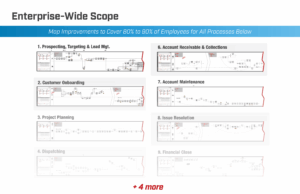
- Make it wall-to-wall. Map every process, from start to finish, regardless of “department.” Include every activity from initiation at a physical POS station or e-commerce checkout, all the way through settlement of funds from the acquiring bank into the merchant account.
- Knock down artificial barriers. Organizational silos have no place in your global payments process-mapping initiative. Your map should include the complete customer’s journey, all back-office activities, and every regulatory or compliance check-point.
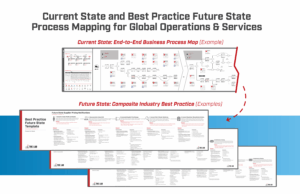
While process maps differ according to the industry and organization, here’s a representative map for illustrative purposes:
Which systems should be included in your global payments process map?
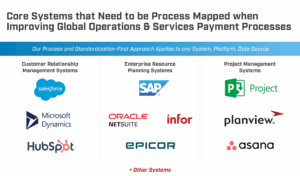
Whether you toil in cross-border and stablecoin processing, digital wallets and contactless payments, or biometric authentication, your global shared services’ payments operation uses a lot of different core and ancillary systems.
Which ones should be included in your process map? All of them, since they figure in all your processes, and directly impact your organization’s ability to calculate interest, connect to payment networks and gateways, ensure regulatory compliance, and provide seamless transaction support across all mobile, banking, and third-party platforms. You will want to include in your process map:
- Core banking systems, such as Thought Machine’s Vault Core, and cores from FIS and Fiserv.
- Payment gateways, such as Core Business Technologies’ payment engine.
- Federal and treasury systems used for government payments, such as the Payment Information Repository or PIR, Post Payment System or PPS, and Treasury Check Information System or TCIS.
- Ledger systems used for account management and general ledger (GL) activities and reporting.
- Cloud/API cores, such as Thought Machine, which are making rapid inroads vs. legacy cores.
- And don’t forget your daily ancillary systems, from Excel to Outlook to Word, ERP, CRM, HRIS, data warehouse, plus your shared drives, folders, and more.
Including all of your global payments core and ancillary systems ensures that you map everything they’re used for. The converse applies, too: if you leave any systems out, you miss out on the full benefits of an E2E process map.
The Lab’s 8-Step methodology for Process Mapping in 6 to 8 Weeks
A detailed walkthrough of how end-to-end process mapping gets done, week by week.
Despite the wall-to-wall scope of a global payments process map, The Lab can create one for you in just six to eight weeks. How? Our patented Knowledge Work Transformation™ delivery approach, along with the Knowledge Base we’ve mentioned, includes templates not only of process maps, but best practices applicable to your future state, too. Thus our templatized approach (along with our team of friendly experts) lets us chart, analyze, and process map your E2E global operations, down to the one- to five-minute level of activity, in just six to eight weeks.
These maps are detailed. They include all job roles, the entire customer journey, systems used, and any NIGO (not-in-good order) wasted effort. They also highlight opportunities for standardization of activities and data, as well as the application of technologies such as automation and AI.
Surprisingly, all this detailed scrutiny does not come at an operational cost. You won’t have to shut down, or even slow down, your global payments organization while it’s process-mapped by The Lab. In fact, we’ll only need about 1 – 2 hours, per week, of your subject matter experts’ time, during the engagement.
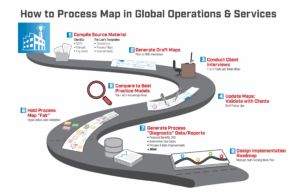
There’s a best practice when it comes to current-state process mapping of your global payments operation—and that’s exactly what The Lab employs. Here are its eight steps:
Global Payments Process Mapping First Step: Collect source material
When you work with The Lab to process-map your global payments operation, the first thing we’ll request will be documentation: Process procedures, workflows, SOPs, org charts, policy manuals, procedure guidelines, operational reports, and similar documentation.
Many clients will feel a little embarrassed at this request, knowing that what we seek can be out of date, incomplete, or wholly nonexistent. We don’t care. We’ll accept sloppy Excel spreadsheets, outdated PowerPoint decks with KPI reports in them; it doesn’t matter to us.
We’ll also want data. Don’t worry: We don’t need any customer-sensitive info; we just want system extracts. That’s all we’ll require to see trends in KPIs such as:
- Invoice processing time
- Payment error rate
- Early payment discount capture
- Authorization and decline rates
- Chargeback ratio
- Payment decline recover rate
- Others
These KPIs directly impact more than productivity. They directly affect revenue protection, cost optimization, and customer experience. They impact your sales effectiveness and gross margin, too.
Once we compare the collected data to the process maps, we’ll model your organizational capacity—a key deliverable. We’ll also quantify the benefits case for improvements. Always know that, despite the many “hats” we wear, The Lab is an implementation firm.
Our Knowledge Base of IP is chock full of templates that apply to your global payments function, such as:
- Templatized current-state and future-state process maps
- Taxonomy organization
- Available business process improvements
- Agentic AI & RPA use-cases
- Reorganization opportunities
- Executive and Management KPIs
- Standardization opportunities
- Industry benchmarks
- Proven peer best practices
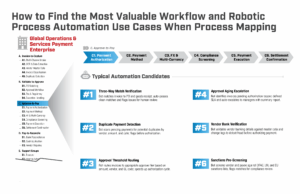
Global Payments Process Mapping Second Step: Draft the maps
With the documentation and data from the First Step in hand, The Lab will draw your v1 global-payments as-is process maps. Note that we draw these prior to engaging with your subject matter experts or SMEs, since we value and respect their time.
We create the actual maps in Microsoft Visio, which we’d mentioned earlier in this article. Since it’s a ubiquitous and readily-available file format, you’re free to update it in the future as you see fit. It also frees you from having to onboard a new software supplier. And while we love doing what we do, we’re also well aware that there’s value in handing off our work—we can’t think of a single global payments organization who wants process-mapping consultants sticking around indefinitely!
Global Payments Process Mapping Third Step: Interview subject matter experts
The initial drafts of the as-is global payments process maps have been drawn. Only now does The Lab engage with your frontline SMEs, who are performing the processes, and running the platforms, that make your operation tick.
Using a video-conferencing/screen-sharing application such as Teams or Zoom, we share the v1 process maps with them, asking them to show us the gaps and to add missing details. This only takes about an hour or two of their time.
Global Payments Process Mapping Fourth Step: Lather, rinse, repeat
The fourth step of process mapping your global shared services operation is similar to the third step. After getting the SMEs’ feedback, we update the maps, and re-share them with the SMEs, layering in more detail each time, over the course of about four weeks.
Why the small increments? The Lab has learned, in our three-decades-plus of doing this, that it’s impossible to recall every single task of a detailed activity in just one sitting. So we iterate across short sprints. This yields the most possible detail of your global payments activity.
Global Payments Process Mapping Fifth Step: Best-practice comparison
After The Lab has drafted your current-state process maps, we’ll compare them to benchmark best practices at global-payments peers. It’s a required step toward identifying—and implementing—the highest-value future state.
Our unique Knowledge Base includes:
- Use cases for agentic AI and RPA
- Industry benchmark data
- Best practices; process improvements
- Executive & Management KPIs
- Jobs and role definitions
- Opportunities for process and data standardization
- Reorganization opportunities
Global Payments Process Mapping Sixth Step: Map Fair
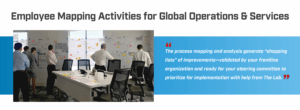
Now it’s time to get feedback from the SME-validated process maps. To do this, The Lab conducts what’s called a Map Fair, in which huge, printed process maps are hung on walls for all to see and react to, across your entire global operations function. We’ll typically do these in common areas in your headquarters, where they can garner the most foot traffic and eyeballs over the course of a two-day span.
The Map Fair lets everyone review and comment (even anonymously, if they like) on the maps; they also plant the seeds of the upcoming process improvements. Everyone is encouraged to mark up the global payments process maps during the Map Fair, using color coded sticky notes: Green means: “Yes, I agree.” Yellow means: “Here’s info which you’d missed.” And red means: “I disagree—strongly.” This helps to validate the fact base on which the map was created. And it generates grass-roots buy-in, since everyone can comment.
Once the Map Fair is over, The Lab reviews all of the color-coded input, and uses it to create a final version of the global payments process map.
Global Payments Process Mapping Seventh Step: Staffing model & capacity
The process-mapping effort, culminating with the Map Fair, typically yields hundreds of available operating-leverage improvements in a global shared services organization. They usually shake out like this:
150 – 200 standardization opportunities, spanning data and processes
100 – 200 agentic AI/automation use-cases
50 – 100 advanced data intelligence/KPI analytics use-cases
All of these improvement opportunities are imported, by The Lab, into a central data repository and analytics dashboard (created in Microsoft Power BI). This way, global payments leaders and teams can easily view, sort, and assign priorities to the different opportunities, in terms of implementation.
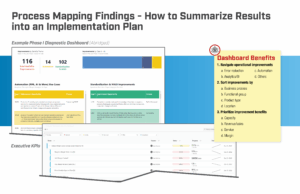
Then The Lab does even more:
- We quantify each improvement opportunity per its time/cost savings, technology adoption level, customer-experience impact, and other metrics.
- We create a capacity model for the entire global shared services organization; it’s used to determine the business case and value/benefits of the various modules and workplans for improvement implementation.
Deliverables from The Lab, at this step, feature:
- Financial benefits and return on investment
- Use cases for agentic AI and automation
- Data/process improvements
- More
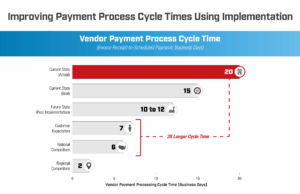
Global Payments Process Mapping Eighth Step: Implementation calendar
As we’d mentioned above, process-mapping your global payments organization will yield hundreds of improvement opportunities. You should implement them all, all at once, right?
Not so fast. The Lab has learned, over our more than three decades of helping organizations like yours, that it’s better to break the big list down into smaller chunks which tee up with your strategy goals for the short, mid, and long term. Fact is, an all-at-once approach is likely to disappoint. As you work with The Lab, we will help with the initial implementation; as the list progresses, your global payments team will be doing more and more of the implementing themselves.
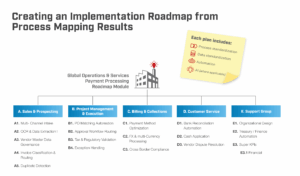
Deliverables from The Lab, at this step, feature:
- A module-based work plan with built-in ROI for self-funding in global shared services, carved up quarter-by-quarter
- Combination of business process improvement, agentic AI, automation, and KPI analytics
- The work plan is created by The Lab, working with your executive leadership team, to follow your strategic transformation roadmap
Once in a blue moon, it is appropriate to employ an all-at-once approach. Not to worry: The Lab has experience here, too, as we have helped with large-scale transformations at leading organizations.
The Five Benefits You Can Expect
From customer experience lift to acquisition readiness: where the ROI shows up.
CX lift for global payments customers
Global Payments Benefit 1 from process mapping: Serve your customers better
No matter if you’re reporting and reconciling merchant transaction records to ensure accuracy or processing chargebacks, you’ll be able to deliver a customer experience or CX lift when you process-map your global payments processing function.
You’ll be able to streamline customer journeys, ensure better regulatory compliance, mitigate fraud risks, reduce security lapses, and more. You’ll deliver better compliance with SLAs, more customer referrals, and newfound opportunities to expand beyond the current scope of your global payments operation.
Maximize your global payments technology investments
Global Payments Benefit 2 from process mapping: Tech stack RO
Global payments technology is continually evolving, from AI and biometric security to real-time/instant payments and digital wallets. Once you have your shared services organization’s process map in-hand, you’ll clearly see where technology fits the different workflows.
- You’ll be able to see where existing technology is under-utilized, i.e., you’re not making the most of features you’ve already paid for.
- You’ll clearly see where new technology is—and at least as importantly, isn’t—needed
Improve risk management and regulatory compliance
Global Payments Benefit 3 from process mapping: Manage risk better
Think about it: When you map out all your global operations processes, you document every single regulatory requirement and compliance checkpoint. Nothing is assumed; reliance on tribal knowledge becomes history.
And considering the unfortunate prevalence of threats such as CNP or card-not-present fraud, account take-overs, and identity theft, you’ll be able to reduce risk, as well, with documented processes, a bulletproof audit trail, reduced process variance, and adherence to best practice at every task and activity.
Increase operating leverage across shared services
Global Payments Benefit 4 from process mapping: Increase productivity/lower costs
Process mapping your global payments organization from end to end shines a bright, inescapable spotlight on slowdowns and other “spaghetti mess” redundancies. See where resources are being put to good use… or not. Thus, your process map is your go-to tool for boosting productivity and efficiency:
· Introduce more automation
- Cut down on rework and mistakes across the entire payment-processing cycle
- Uncover variance between individual performers assigned with similar tasks; increase uniformity of execution
Boost KPIs, with real-time, proactive, automated reporting on metrics such as:
- Payment error rates
- Invoice processing time
- Early payment discount capture
- Payment conversion rate
- Cost per transaction
- Others
Be ready to acquire—or be acquired
Global Payments Benefit 5 from process mapping: Acquisition due diligence
Whether you seek to be on the buy- or sell-side of the transaction, process mapping paves the way for an improved enterprise acquisition environment for global shared services organizations. Having mapped all your global payments customer journeys and internal end-to-end business processes, you’ll increase scalability for buyer and seller alike.
The benefits apply to each party and the combined organization: Opportunities to consolidate are simple to surface. The combined org design is readily apparent, since you’ll be able to compare best-practice conformity in both companies. And your First Hundred Days plan will be even more grounded.
Engage The Lab
From the initial conversation to a fully mapped operation in six to eight weeks.
The Lab has helped executives, tech leaders, and internal excellence teams to process map their wall-to-wall activities and customer journeys in as little as six to eight weeks… and we’ve been helping organizations like your global payments business for more than 30 years.
Let us help you to reduce costs, increase operating leverage, elevate customer experience, and eliminate waste and redundancy. We can identify, and implement, opportunities for agentic AI, robotic workforce automation, and advanced data intelligence and KPI reporting. Our comprehensive solutions deliver measurable results, drive success, and reduce employee turnover.
Ready to transform your global payments operation? Book your demo with The Lab’s friendly experts; simply call (201) 526-1200 or email info@thelabconsulting.com today.