















Best-Practice Techniques for Process Mapping Your Retail Business
By following best practice, you can process-map everything from procurement to inventory management, sales, and fulfillment in only six to eight weeks
Few industries are as fiercely competitive—or rapidly evolving—as retail. From in-store to online and mobile, retail executives are faced with a number of challenges which often seem at odds with one another:
- Managing economic pressures such as inflation, which can erode brand loyalty.
- Going beyond “mere” omnichannel to enable unified commerce in a new “phygital” (physical + digital) world.
- Keeping pace with evolving consumer behavior, as they expect AI-driven personalization and tools like visual lookups of products.
- Supply-chain management to prevent stock-outs or over-stocking.
- Labor shortages and rising minimum wages.
- Adapting new innovations across the retail technology stack, whether in legacy systems such as POS (point-of-sale) and inventory management (IMS) or adding AI for capabilities such as agentic commerce.
The future-state of retail is moving fast. But you can’t get there until you have a granular understanding of your retail operation’s current state. That’s why retail executives (as well as their business unit and technology leads and internal improvement teams) must begin any transformation initiative with current-state, end-to-end (E2E) process mapping.
As we’d hinted above, your retail future state likely features a lot of empowering technologies, such as cashier-less stores, automated labor and inventory bots, and using agentic AI, automation, and predictive analytics. But you must know the present before you can chart the future.
In this long-form article from The Lab, we will provide an “explainer” for you so you can learn how to process-map your retail business. We’ll show you how it can be accomplished in just six to eight weeks. And we’ll teach you how process mapping in retail is Step One on your analytics, AI, automation, and continuous-improvement roadmap.
What trends are affecting retailers?
External challenges and factors which are impacting retail process mapping
While the technologies are rapidly evolving, some of the challenges of retail are as old as the corner five-and-dime store. Your process mapping in retail must eliminate every penny of “leaking” profit, while onboarding digital workers (i.e., “bots” or automation), increasing operational agility across the supply chain, addressing security threats to both inventory and customer data, and more.
And then there are the market forces which are rapidly re-shaping the retail landscape:
- The trend toward hyper-personalization, wherein shoppers expect AI agents to make recommendations and even fulfill orders to earn and retain their loyalty.
- The move toward “experiential retail,” where consumers want more from your physical locations than just transactions.
- Adoption of circular-economy best practices, including everything from embracing the second-hand luxury market to price-driven surges in private-label brands and the “buy less, buy better” movement.
- Updates in core and ancillary retail systems—everything from order-management systems to CRMs—which often don’t communicate with one another.
- Rising retail crime, including theft and fraud.
- Shifts in regulations and compliance.
Given all of these challenges, you simply can’t look toward the future of retail without process mapping your E2E current state.
Will I need to replace my retail systems as part of my process mapping?
How to unlock the value of your retail technology stack during process mapping
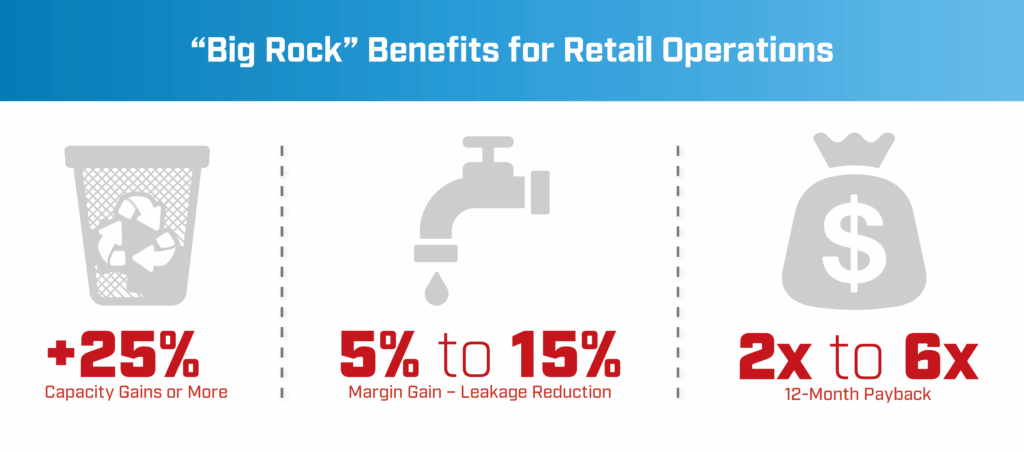
In order to grow and preserve margin, while improving the customer experience, retail executives must uncover and exploit every opportunity for expanding operational efficiency and scalable capacity.
The best way to proceed is to put process before technology; this is an approach employed by The Lab. It puts a priority on squeezing the maximum value out of your existing retail technology first. Only then does it seek to add on capabilities such as agentic AI in retail and digital workers or retail robotic process automation (RPA). That’s good news for retailers, because it protects their often sizable investments in systems such as:
- Point of sale systems (POS)
- Inventory management systems (IMS)
- Order management systems (OMS)
- CRM or customer relationship management platforms
- eCommerce platforms (such as Shopify and others)
- ERP or enterprise resource planning systems
- Accounting/financial
- HRIS
- Others
In this long-form explainer article from The Lab, we will show you how, as a retailer, you can employ process mapping of your retail operation to improve margin, elevate the customer experience, and increase operating leverage, all at the same time… in only 6 to 8 weeks. This is a key part of The Lab’s service offering to retail leaders.
Where are the “hidden” opportunities in retail process mapping?
Retail process-mapping partners for executives: Selection criteria
You can process map your retail operations yourself. Or you can engage an external partner to help, such as The Lab. Regardless of how you proceed, you’ll want to perform all of the following, across each of your retail work flows:
- Visualize
- Analyze
- Study
- Uncover retail process-improvement opportunities
- Spotlight any effort that’s wasted
- Find resource waste
- Track, monitor, and measure retail key performance indicators or KPIs
- Find the highest-value opportunities for agentic AI and automation in retail
This will let you envision and then implement a retail future state where operational performance and productivity are maximized.
When you map your cross-functional retail operational tasks and activities, you’ll then be able to:
- Cut costs
- Get more out of your retail technology stack
- Improve customer service and experience across all channels
- Lift enterprise value
This article from The Lab will give you clear and simple instructions for mapping all of the processes in your retail enterprise. It will show you the pitfalls to avoid, and the best tools to employ.
You’ll learn, for example, how you can cut down on performance variance on identical activities, boosting essential KPIs by quartiles in less than a year. The Lab has been serving executives like you for more than 30 years. An essential element of The Lab’s success with its executive sponsors can be found in its Knowledge Base of actual client-engagement IP amassed across all those decades, which can be quickly and cost-effectively transferred directly to your specific retail operation.
What’s the best definition of process mapping for retail operations?
How do you define “process mapping in retail”?
Process mapping in retail is defined as depicting, via graphical visuals, all of your E2E retail activities and work flows, from beginning to end. Typically, a retail process map looks like a flow chart or diagram.
Mapping your retail processes not only reveals what’s being done every day. It also reveals what can be improved.
And the more detail (generally), the better. You’ll want to break down big processes into “bite-sized chunks” with discrete steps in each. The goal is to maximize your visibility into current-state retail operations. The more you uncover, the more you can improve.
Process Map Your Retail Operations
What are the 3 steps for retail process mapping?
Without the help of external consulting vendors like The Lab, it often takes retailers months—and sometimes years—to map all of the processes in their retail operations. Drawing the actual maps is easy. You could even say that it’s fun. But the prerequisites are more time-consuming and labor-intensive. Here, then, is an overview of how to process map your retail operation:
Retail Process Mapping First Step: The planning
This step, which usually takes anywhere from three months to 1.5 years, features:
- Finding a retail enterprise-wide issue which requires a fix
- The same could occur at the business-unit level
- Selecting an appropriate C-suite project sponsor for process mapping
- Listing all of the retail process-mapping’s sought-for strategic outcomes
- Ensuring a benefit-rich, cross-functional scope
- Gaining retail department and organization buy-in
Retail Process Mapping Second Step: Mapping & analysis
With The Lab as your process-mapping partner, this step can be done in just 6-8 weeks:
- Pull together your existing retail SOPs/procedures, even if outdated
- Inventory all in-use retail systems
- List all data types for each system
- Interview front-line SMEs or subject-matter experts
- Document individual tasks visually, at 1- to 5-minute detail
- Conduct a Retail Map Fair so you can uncover additional improvements from other teams and contributors
- Catalog (and create a taxonomy for) the identified improvements for future-state implementation
- Write up the business case and retail transformation execution plan
Retail Process Mapping Third Step: Implementing transformation & improvements
Typically taking retailers about 3 months to a year, this step features:
- Impanel the implementation and support teams
- Standardize retail business processes
- Reduce or eliminate wasteful or redundant processes
- Improve retail data quality across the different systems
- Introduce agentic AI, digital workers/automation, advanced analytics, and also automated reporting
- Use Executive and Management KPIs to sustain the transformation effort
Top internal vs. external resources for retail process mapping
Is it best to perform retail process mapping yourself, or consult others?
For a grand-scale transformation, such as would happen in a merger/acquisition environment or while onboarding a new core system, the biggest retailers usually offload their process mapping to external consultants who specialize in this. That’s because, even with their large size, these retailers typically don’t have a mature team, in-house, that can simply pivot to full-time retail process mapping.
About 75% of mid-sized retailers are in the same boat: they don’t have the in-house resources to tap for a full-time process-mapping initiative.
Process Mapping Resources (Part 1)
What are the titles of internal people best suited to perform process mapping in retail?
Your retail organization may already have a mature internal improvement capability, replete with Lean Six Sigma Black Belts, for example. If that’s the case, you likely have many of the people you will need to perform current-state process-mapping of your retail business. Their skills will be better suited to the job than those, say, in your IT function.
Look for the following titles within your retail business:
- Business Analyst
- Process Engineer
- Data scientist—if you have any, they can move into the role of business analyst, if they have sufficient process experience
Process Mapping Resources (Part 2)
How do external consultants perform process mapping for retail operations?
External consulting firms such as The Lab, which specialize in process mapping, can be a good choice for your retail business. The Lab lets you offload most of the difficult labor, and can do the following process-mapping activities faster than your internal people could:
- Perform and oversee the retail process-mapping initiative
- Draft the current-state retail process maps
- Use teaching methodology which has been continually tested and improved over the course of scores of client engagements for over three decades
As we’d noted earlier in this article, that vast store of client-engagement IP has been standardized and semantically codified in The Lab’s Knowledge Base in the form of:
- Tools
- Templates
- Process maps
- Advanced analytics tools
- AI
- Best practices
- Executive and management KPIs
- “Bot” code
- More
Which vendor provides the best retail process mapping services?
What are the benefits of using an outside consultancy for retail process mapping?
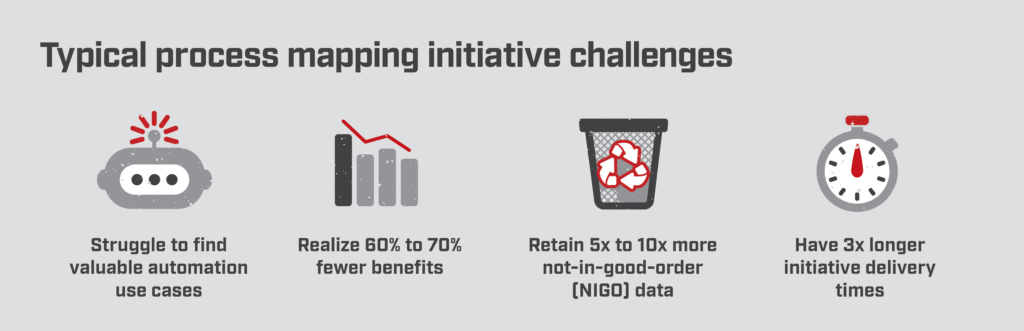
When performed by The Lab, process mapping for retail businesses surmounts the typical shortfalls and delays from using either traditional consultancies or trying to do it all internally. The advantages include:
- Quicker retail analysis. The Lab only requires about an hour per week from your subject matter experts (SMEs), for about six to eight weeks. Thus it’s respectful of their time, and the retail process mapping proceeds faster.
- More benefits from retail process mapping. The Lab helps retail leaders to uncover fresh opportunities for eliminating redundant effort, find new control points, and ID opportunities for AI and robotic process automation or RPA in retail. Since the process mapping is E2E, you’ll get benefits from broad-scope to discrete tasks and activities.
- More ultimate benefits from retail process mapping. Your leaders and teams will gain newfound ability to determine the specific capacity requirements for every single retail business process and department. Working with The Lab, you’ll get a a detailed implementation benefits case.
- Implement best practices easily. The Lab will benchmark your retail operations against best practice, showing you how it stacks up vs. peers. We can identify competitive gaps, pointing the way toward an improved to-be retail operational
How to choose the right software for retail process mapping
Which process-mapping tools are best for retail enterprises?
Our use of the word “software” in the headline above is actually a little misleading. That’s because not every available tool for process mapping your retail business is digital. Consider these two “classics”:
Butcher paper. Brown or white rolls of “butcher paper” are often used, for a number of reasons:
- They’re large, so you can easily tape them up on a wall.
- You can easily add lots of post-it’s.
- Traditional process-mapping consultants often prefer butcher paper.
Dry-erase whiteboard. The classic dry-erase whiteboard can be used for retail process mapping, too:
- They’re “Pictionary” fast. You can rapidly sketch out an idea or rough map, often in just seconds.
Since they’re big, everyone in the room can see them at once.
Of course, there are digital/software options, too:
Microsoft Visio for retail process mapping. This is the number-one ubiquitous tool for process mapping in all industries, not just retail:
- Since you already have Microsoft, you already have Visio.
- For more than ten years, it’s been the world’s most popular process-mapping software.
- It is easily installed thanks to your existing Microsoft Office 365 setup.
Signavio for retail process mapping. This is one of many Visio competitors like Mirco, Lucidchart, and Diagrams.net :
- Signavio is based in the cloud.
- It’s a decent Visio alternative.
IBM Blueworks for retail process mapping. This is a cloud-based process-mapping platform. But…
- It’s a proprietary IBM product.
- It’s not nearly as popular as the other options we’d listed above.
How does your retail operation compare to peers?
What is the scope of process mapping in retail?
Not every retailer is as massive as, say, a certain one we all know from Bentonville, Arkansas. But that doesn’t mean that there aren’t similarities among all of them, including yours.
You might be surprised to learn just how much size doesn’t matter when it comes to scoping your retail process-mapping initiative. Scores of retail processes, after all, are identical, regardless of retailer, such as:
- Procurement activities like purchasing products.
- Inventory management processes including receiving, stocking, and then tracking.
- Transactional sales activities, including POS, online checkout, and other phases of customer acquisition and sales.
- Logistics and fulfillment activities including shipping and in-store pickup.
- Many others.
Viewed in this way, you can quickly see that 75 percent of your retail processes are similar to other retailers’ processes.
Indeed, the way the actual differences shake out, in practice, is dependent upon how the original workflows were configured by the different implementation teams in the various systems used in your retail operation.
Process Mapping Best Practices
What are the 4 most important best practices for retail process-map scoping?
Systems Included In Process Mapping
Which systems should I include in my retail process map?
Just as you shouldn’t let internal silos prevent you from mapping every department in your retail organization, you shouldn’t overlook any of the systems you employ. These include systems that are more prevalent in retail vs. other industries:
- POS (point-of-sale) systems for processing transactions, payments, and linking retail sales with data residing online.
- IMS (inventory management system) for tracking stock levels and optimizing inventory across your retail footprint and warehouses.
- OMS (order management system) for enabling multi-channel fulfillment spanning online, in-store, and mobile.
- eCommerce platforms, such as Shopify, for managing your online storefront, digital sales, and catalog offerings.
- Retail analytics software to gauge sales performance, turnover in inventory, and retail customer behavior.
But they also include all of your commonly-used core and ancillary systems as well:
- ERP: Enterprise resource planning platform
- Data warehouse
- CRM: Customer relationship management platform
- HRIS: Human resources information system
- Many others
Including all of the systems your retail operation uses in your process-mapping will deliver the end-to-end detail you need. Conversely, you wouldn’t want to limit your map-scope to just one system; doing so would kneecap your ability to get enterprise-wide benefit from process mapping in retail.
Six- to eight-week process mapping services available from The Lab
Can retail operations be processed mapped in less than eight weeks?
The Lab’s patented Knowledge Work Transformation™ methodology, combined with templates for future-state best practices, allows for accelerated delivery. Taken together, The Lab is able to document, and then analyze and process map your retail business, from wall to wall, in just 6 to 8 weeks.
The Lab maps all retail processes down to the detail of activities that last a mere one to five minutes. Operational details and improvements are added to the current-state retail process map, including customer touch-points, job roles, and systems being used throughout the retail enterprise. We also identify what we call NIGO or “not-in-good-order” activities, and point up opportunities for standardizing activities, and introducing technologies such as agentic AI in retail and RPA or robotic process automation.
Won’t my retail subject matter experts (SMEs) be overloaded by process mapping?
The Lab understands how important your retail team is, especially the SMEs who are performing activities and working across various systems. Fortunately, The Lab’s “process-mapping process” is minimally intrusive, requiring only about an hour or two of your SMEs’ time, per week. So your retail business can proceed, even while the process mapping is underway.
Increase operating leverage and scalable capacity
1. Retail process mapping benefit: Cost saving
Retail process mapping uncovers inefficiencies and work-flow bottlenecks that have been hiding for ages. After you visualize each component activity, you reveal redundant tasks and wasted resources, helping you to streamline activities and improve productivity. This will quickly empower your retail enterprise to:
- Decrease errors and rework across all channels
- Automate more of your value-added activities
- Decrease variance for similar tasks among individual performers
- Optimize capacity of retail footprint and warehouse operations
As an example, you’ll gain newfound ability to view—and act on—margin-relevant KPIs like:
- Negative-margin products
- Gross margins return on investment or GMROI
- Average order value
- Customer lifetime value
- Average transaction value
- Customer acquisition cost (CAC)
- Customer retention rate
- Inventory turnover ratio
- Foot and digital traffic
- Return on ad spend (ROAS)
- Total margin “Leaked”
- More
CX lift
2. Retail process mapping benefit: Elevate customer experience
Retail is all about serving your customers. Mapping your processes includes mapping all of your customer journeys, across all channels. This will let you “blur the lines” between your different channels, providing a uniform and seamless experience for every shopper and customer.
You’ll be able to eliminate their pain points—everything from lost sales from stock-outs to long checkout lines—to smooth their experience and build their loyalty. Process mapping can help you reach for the goal of “out-Amazon-ing Amazon” via:
- More opportunities to upsell and cross-sell
- Improved NPS or Net Promoter Score
- Opportunities for adding new products and/or services, with increased likelihood of customer approval and uptake
Expanded technology utilization
3. Retail process mapping benefit: Max out your tech stack
Retail technology is continually advancing: everything from inventory bots to AI shopping agents and image-based product discovery. When you process-map your retail enterprise, you can maximize the value of your existing technology stack, while paving the way for the most cost-effective adoption of new and emerging technologies.
By “blueprinting” your extant workflows, it’s not a huge leap to see where the new tech will best fit your retail organization and strategy:
- Pinpoint where existing retail tech is being under-utilized (no upgrade required!)
- Reduce the capital investment of new retail technology
- Maximize existing tech’s benefits and investment
- Speed the adoption of new tech when needed
Increase compliance in retail operations
4. Retail process mapping benefit: Reduce risk
As a retailer, your brand reputation is your lifeblood. Avoid dings—not to mention penalties, liability, or regulatory action—with the help of retail process mapping.
How? Process mapping in retail ensures that all of your workflows comport to regulatory requirements. Each step will be defined, with every component compliance-check highlighted.
Retail process mapping also elevates your risk management. It identifies weak or missing controls, helping you to implement stronger safeguards. When you process-map your retail operation, you’ll get:
- A better end-to-end audit trail
- Documented compliance checkpoints throughout
- Best-practice risk mitigation
- Reduced variance
- Increased uniformity of all risk- and compliance-related activities
Elevate your business’s readiness for M&A activities
5. Retail process mapping benefit: Be ready for acquisition time
It doesn’t matter if you’re seeking to purchase another retail business or preparing your own operation to be a maximum-value acquisition target. In either case, process-mapping and improvement let you ID all business processes and retail customer journeys.
This, in turn, empowers you to create the most scalable future state for both the acquiring and acquired businesses. Remember: The same activities which confer benefits for one business are multiplied in an M&A situation:
- Consolidation opportunities can now be easily ID’ed
- Single vs. combined organizational design
- Best-practice overlays reveal gaps in both acquiring and acquired businesses
- Accelerate 100-day integration plan
Process Mapping Best Practices
What is the best practice methodology for process mapping in retail?
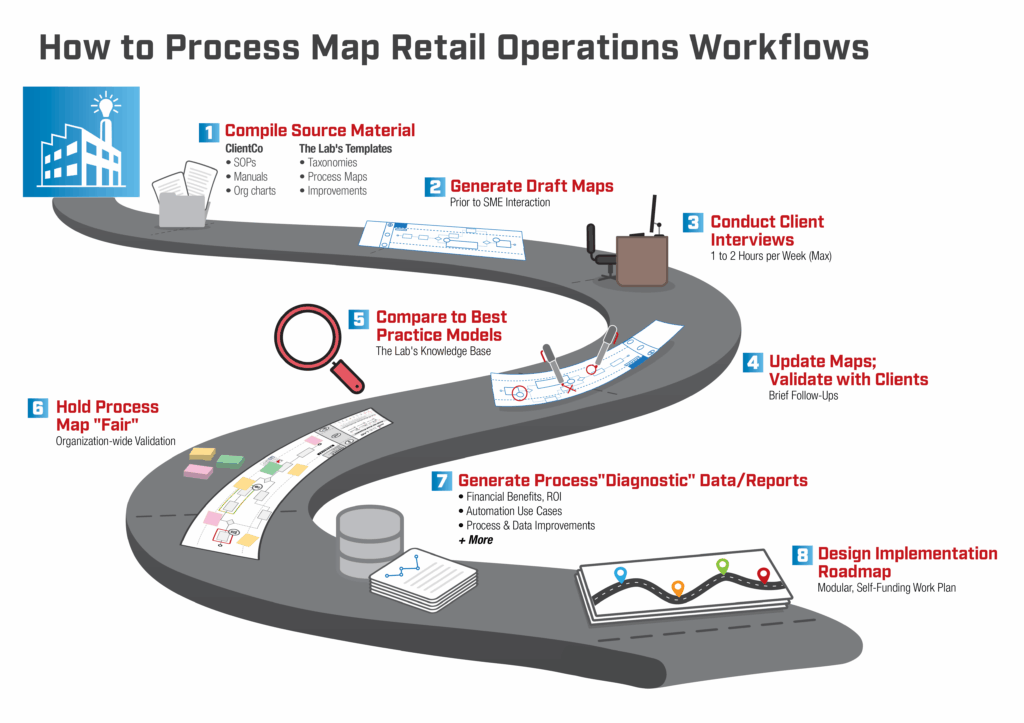
There are eight key steps to follow, in order, to process-map your retail operation. These, not coincidentally, are the same steps which The Lab follows:
Retail process mapping best practice 1
Assemble all source material/data
When The Lab begins a current-state retail process-mapping engagement with a client, we first request all source materials and system data. This includes:
- Policies
- Procedure manuals
- SOPs
That’s not all. The Lab will also request previous reporting material—all of it. And it can be in any condition, from napkin notes to Excel spreadsheets to partial/incomplete PowerPoint decks.
Why does The Lab want all of this data? The answer is simple: To ingest as much information as possible before engaging with your retail operation’s subject matter experts or SMEs.
The retail data dump for process mapping
The Lab will request more than printed manuals, spreadsheets, and presentation decks. You’ll be asked to provide extracts of data from all of the different systems your retail business employs.
Before you can say “PII” or “personally identifiable information,” don’t worry. The Lab will neither request nor want it. Instead, simply provide redacted information, devoid of any customer details. Because, even redacted, these “retail data dumps” can be used to reveal essential retail KPIs such as :
- Foot/online traffic
- Sales per square foot
- Visitor-to-buyer conversion rates
- Average transaction/order value
- Inventory turnover/stock-speed rates
- Sales per employee
- Sell-through rate
- Customer acquisition cost for ecommerce
- Cart abandonment rate
- Gross margin
- Shrinkage
- Online/mobile order-to-shipment cycle times
- On-time delivery rates
- Order error rates
- Incident resolution cycle times
- Overstock/stock-out rates
- Restock/refurbish/disposal rates
- Others
As you can see, these KPIs span productivity, sales effectiveness, and margin.
The Lab will compare the collected data to the process maps to model the current capacity of your retail operation, and create a quantified business case for implementation. After all, The Lab is an implementation business.
The IP Knowledge Base from The Lab features retail-relevant templates such as:
- Retail process maps
- Retail-focused taxonomy
- Process improvements for retail which include:
- Retail standardization opportunities
- Benchmarks vs. peers
- Best practices
- AI and automation/digital workforce use-cases
- Reorganization
- KPIs
Retail process mapping best practice 2
First-pass draft of actual as-is map
As you can see, Step 1 entails a lot of data: requested, supplied, and ingested. Using all of this data, along with the templates in its Knowledge Base, The Lab will draw the v1 process map of your retail organization. As noted before, all of this work is done prior to engaging with your SMEs, to be as respectful of their time as possible.
Retail process maps in Visio
We’ve mentioned automation in this article many times—know that The Lab uses trained bots to draw your v1 process maps directly in Microsoft Visio.
Why Viso? Per our “tools” discussion earlier, we’d noted that Visio, as a Microsoft product, is ubiquitous. So The Lab can hand off the Visio maps to your retail business. Since you already have Microsoft/Visio, you’re free to update the maps as you like in the future, after The Lab has departed. (What retail business, after all, wants consultants poking around their ops forever?)
Incidentally, another benefit of having the retail process maps delivered to you in Visio is that it saves you from adding—and paying for—another tech vendor.
Retail process mapping best practice 3
Subject matter expert engagement
This step has been delayed (and teased in this article) for a while, but now it’s time to officially interview the front-line retail subject matter experts or SMEs who are doing the work in the trenches. Here, this means everyday activities such as purchasing, in-store management, training, sales, order fulfillment, inventory/warehouse, processing returns, and more.
The Lab will share the v1 process maps with these SMEs, asking them to point out any gaps in the processes within their purview. They also can quickly supply more detail to mapped activities that require them.
Thanks to the data-in-advance sequencing, as well as the templatized maps and automated drafting thereof, all of this happens very fast. In fact, your retail SMEs will only need to be consulted for about an hour or two per week. This lets them remain focused on their daily activities.
Retail process mapping best practice 4
Update maps via “lather, rinse, repeat”
Over the course of about 4 weeks, The Lab will update and iterate the maps, working with your SMEs to close gaps and add detail.
Fact is, no SME, no matter how seasoned, can truly recall every single detail of a daily activity at a single sitting. That’s why The Lab employs this iterative “lather, rinse, repeat” process, with multiple brief interactions, spread out across a few weeks. It’s the best practice for creating a retail process map that truly represents the current state—and paves the way for the future state.
Retail process mapping best practice 5
Best-practice comparison
How does your retail operation compare to best-practice peers? That’s the question that gets answered by The Lab in Step 5. It’s vital for uncovering the maximum-benefit future state to implement.
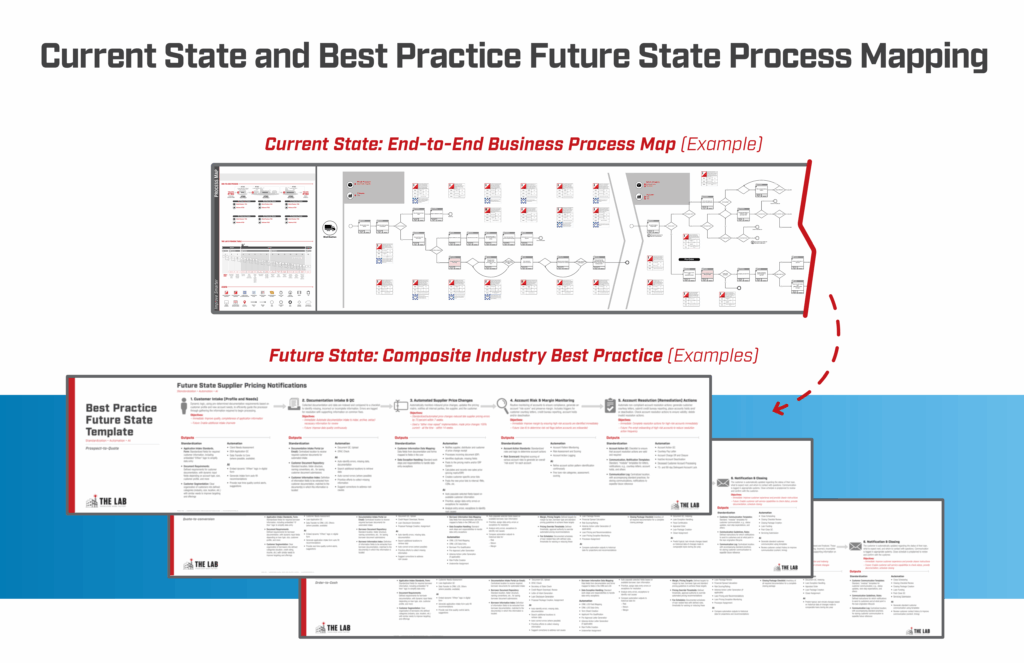
The retail best practice models within The Lab’s Knowledge base include:
- Job/role descriptions
- Automation/agentic AI use cases
- Benchmarks
- Process improvements: Best practices
- KPIs or Key Performance Indicators
- Process/data standardization opportunities
- Opportunities for reorganization
Retail process mapping best practice 6
Map fair
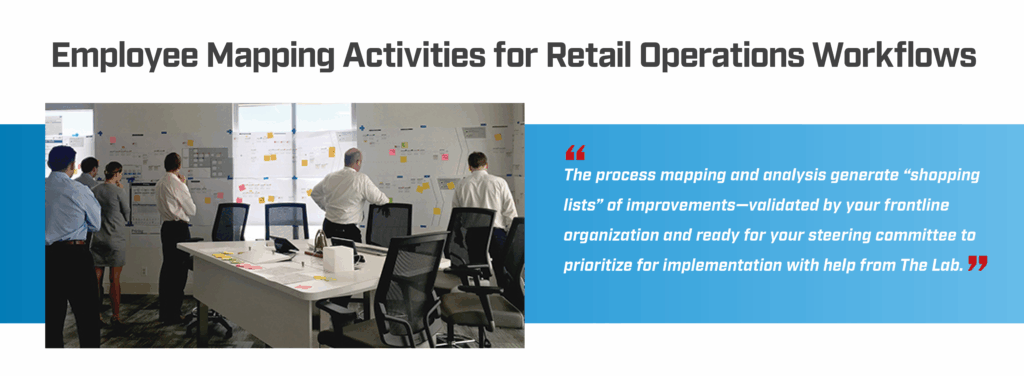
At this point, The Lab will conduct a two-day Map Fair with your team. That’s because all of the prerequisites of mapping and initial SME validation have been completed.
The Lab will print out big-scale maps and post them in common areas within your retail headquarters, so everyone can see them at their leisure. (Remote locations can be served virtually.)
At the Map Fair, your retail staff will be free to contribute—even anonymously, if they prefer. The goal is to validate the map and its underlying fact base of processes. Not only does the Map Fair let everyone view it in a no-pressure setting, but it also paves the way for the process improvements it will identify. The Map Fair allows for org-wide consensus, since everyone is free to add their feedback.
Specifically, Map Fair visitors are encouraged to mark up the map with color-coded sticky notes: Green for “I agree”; yellow for “Needs more information,” and red for “I strongly disagree.”
Once the retail Map Fair is over, The Lab analyzes the sticky notes, and reconciles them into the map—which, at this point, is considered “final.”
Retail process mapping best practice 7
Model organization capacity
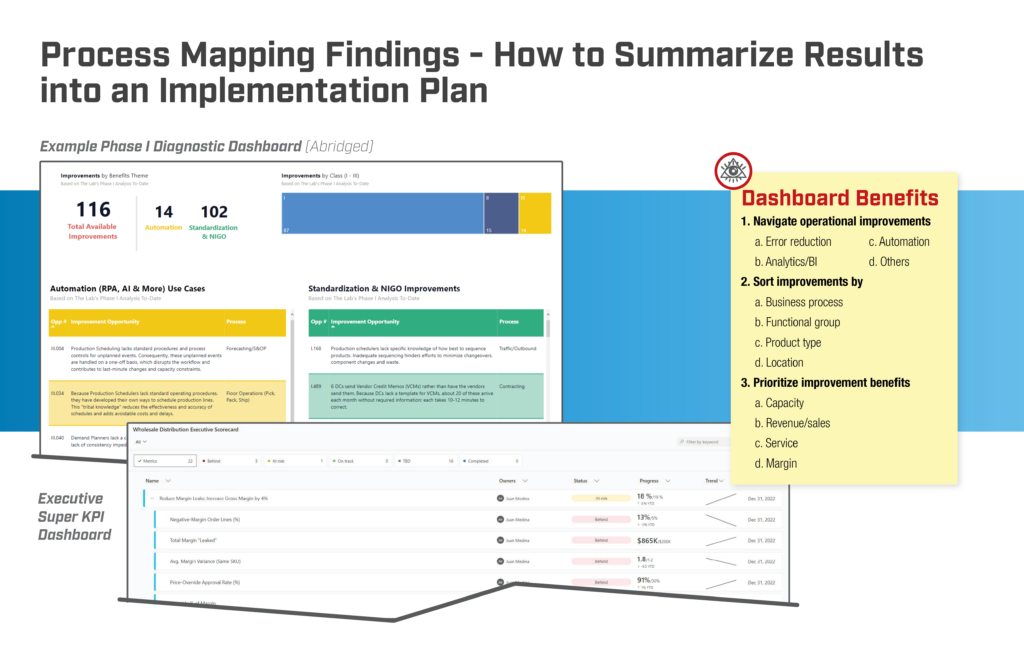
After the two-day Map Fair in retail is complete, The Lab—and you—will have hundreds of improvements to choose from for implementation. A typical retail “improvement inventory” will feature:
- ~ 50 to 100 advanced analytics use cases
- ~ 150 to 250 opportunities for process/data standardization
- ~ 100 to 200 use-cases for AI/RPA automation
The Lab will compile all of these improvement opportunities in an easily accessible centralized database, as well as a dashboard (created in Power BI), making it easy to visualize, prioritize, and plan which improvement opportunities to implement—and when.
How are retail improvement opportunities from process-mapping ranked?
The way to rank, order, and prioritize the identified opportunities—whether they’re AI, automation, process/data standardization, or advanced analytics—is to quantify them according to their:
- Financial benefits
- Time savings provided
- Elevation of customer experience
- Underutilization of tech stack
- Others
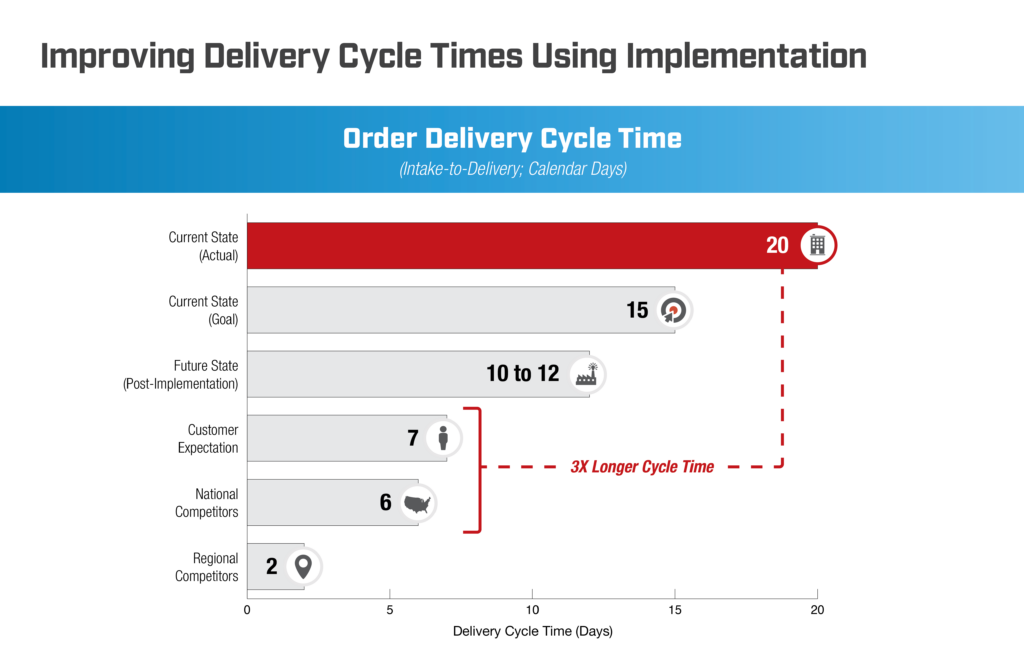
The Lab will do all of this quantifying for you. The Lab will also model your retail business’s organization capacity; it will serve as the basis for determining the business case (and thus value) of work plans, implementation, and modules. Among the deliverables you’ll receive are:
- Use cases for AI and RPA robotic process automation
- Financial benefits & ROI
- Retail process improvements
- Retail data improvements
- More
Retail process mapping best practice 8
Draw up the implementation calendar
Is it better to implement all of the identified improvements in one “big bang,” or take a more incremental approach?
The Lab has found, over the years, that it’s almost always better for retailers to take the latter path: that is, employing modular implementation plans which tee up with their short-term, mid-term, and long-term strategies. This is generally the case, regardless of how complex your retail organization, as mapped, is.
In the beginning, The Lab helps to implement the identified improvements. Gradually, however, the burden shifts, and retail businesses are able to self-implement by the end.
Step 8 deliverables, jointly designed by The Lab and the retail organization’s executive steering committee to meet their strategic objectives, include:
- Implementation schedule, broken out by quarters each year
- A self-funding retail workplan for retail
- Optimum mix of:
- Process improvement
- Agentic AI
- RPA automation (digital workers)
- Executive & Management Retail KPI analytics
Are there exceptions to the “modular improvement” implementation rule?
Yes, there are always exceptions. When it’s appropriate, a “big bang” implementation of virtually all identified improvements is warranted. Indeed, The Lab has helped some of the biggest re-organizations during challenging times.
Contact The Lab Consulting Today!
Transform your retail enterprise with help from The Lab
The Lab has helped C-suite executives, business-unit and technology leads, and internal-improvement teams to map all of their organizations’ business processes and customer journeys.
We’ve helped them streamline operations, elevate customer experience, and reap substantial cost savings. We identify and implement agentic AI, digital workforce/automation, and data intelligence/advanced analytics. All of the above serve to expand process resiliency and hedge against employee turnover. Our comprehensive solutions deliver measurable, success-driving results.
Ready to transform your retail organization? To book your screen-sharing demo, call (201) 526-1200 or email info@thelabconsulting.com today.