















Best-Practice Standardization for Professional Services Firms
Learn how to increase productivity 24% – 39% while adding AI, automation, and KPI analytics
Strategic Context
Operational Transformation for Professional Services Leaders
It does not matter what type of professional services firm you run, whether as an executive, technology (or business-unit) leader, or even part of an internal improvement team. Your firm could compete in accounting, legal, IT/cybersecurity, engineering, PR, HR, among others. As a leader at a knowledge-work organization, you know that transformation means improving operating leverage.
And as you contend with pressures ranging from talent scarcity to increased demand for performance-based pricing, you want to identify every operational improvement opportunity.
But where are they? The Lab has been serving professional services firms for more than three decades; during that time, we’ve amassed all of that client-engagement IP into our Knowledge Base; it’s what informs our patented Knowledge Work Standardization® methodology. And that Knowledge Base has uncovered some interesting truths about the way that professional services firms operate:
Specifically, professional service knowledge workers spend more than 35% of their days on the following activities:
- Fixing mistakes
- Redundant activities
- Providing more service than clients are paying for
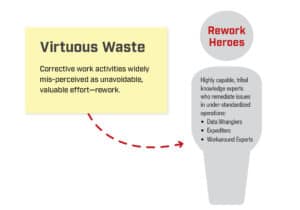
The Lab terms these inefficient activities “Virtuous Waste®.” The people engaging in this daily wasteful activity, including staffers and managers, don’t recognize it as waste. They consider it to be required and valuable work. When in reality it provides no business benefit.
The Problem: Industry Orthodoxies
The Earnings-Reducing Assumptions of Professional Services
The professional services world, by its nature, lends itself to a number of orthodoxies and/or assumptions that can really prove toxic. These assumptions can be challenged and dismantled. Addressing them can increase earnings by more than 20%.
What, then, are these ingrained professional-services orthodoxies?
- Professional Services Orthodoxy 1: “Our firm is unique, and so is our way of doing things.” First off, you have competition, and prospects must choose between you and your peers. Secondly, many of their processes are actually quite similar to yours. Therefore, your firm and its processes are not unique.
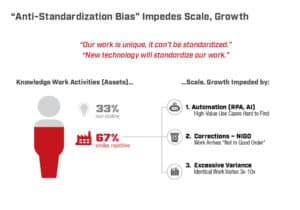
- Professional Services Orthodoxy 2: “You can’t standardize what we do. It’s unique, one-off knowledge work.” When you scrutinize what’s being done in your professional services business, not only will you see opportunities to standardize knowledge work; you will see overwhelming opportunities to standardize knowledge work. In fact, 66% of your professional services firm’s current activities can be standardized. That’s the underlying truth, and foundation, for this entire long-form explainer article from The Lab.
- Professional Services Orthodoxy 3: “The latest technology will automate our professional services firm.” With enticing names like “professional services automation” platforms, you might think that they will do the automating for you. Automating Virtuous Waste would simply institutionalize inefficiency. Organizations must eliminate these wasteful activities before implementing automation. Many professional services firms overlook this prerequisite, leading to this assumption.
This article from The Lab will help you learn more about our patented Knowledge Work Standardization implementation methodology. You will see how it uncovers and decreases Virtuous Waste, simultaneously increasing operational efficiency and scalable capacity for professional services firms. You will also learn how this approach enables professional services firms to more easily onboard technologies such as agentic AI, digital workers (“bots”), and management/executive KPI advanced analytics and automated reporting.
The Solution Framework
Knowledge Work Standardization for Professional Services
For professional services firms, the definition of Knowledge Work Standardization is: “An approach that puts process before technology to strategically improve professional services businesses via transformation and its benefits, enterprise-wide.” As we noted above, taking this standardization-first approach, which prioritizes processes, opens new avenues for tech such as AI, RPA (robotic process automation and other forms of digital workers), and advanced data intelligence. When you standardize your professional services firm, you will retain more margin… up to 2.6 points. You will boost productivity, anywhere from 24% to 39%. And you will increase client retention rates and project profitability via better market segmentation and performance analytics. Want to see Knowledge Work Standardization in action? View this 5-minute video from The Lab. These are often called the “5 W’s” of professional services standardization. When you ask and answer these questions, you will open your firm up to enterprise value lift and benefits:
What is to be standardized?
Answer: All professional services processes and data require standardization. This comprehensive approach will be detailed further in the implementation methodology.
Who’s to be standardized?
Answer: All functions and departments involved in these processes and data.
Where is the standardization going to happen?
Answer: Each platform utilized within the processes and data, from wall-to-wall or end-to-end.
Why is this being standardized?
Answer: This is your first and best choice for capturing and unlocking the most strategic transformation benefits and value.
When shall we standardize?
Answer: Implementation should begin immediately. Delayed action increases opportunity costs. The Lab’s patented Knowledge Work Standardization methodology can standardize professional services firms within 6-12 months.
Success Factors & Pitfalls
Avoiding Common Traps and Maximizing Value
When you standardize your professional services firm in order to reap the benefits of strategic transformation, there are pitfalls to avoid. The most common of these is what’s called false precision.
As its name implies, it’s the assumption that “more precision is better.” Have you ever heard of “analysis paralysis”? That’s a similar trap. You want to uncover what to standardize and standardize it. However, you should not focus on excessive detail such as timing individual activities to the minute. If you encounter people who insist on this level of “precision” when you standardize your professional services firm, push back.
An analogy: When you process map your professional services firm, you want to uncover opportunities for improvement. However, you do not need to quantify everyone that you find.
There is an optimum level of precision when it comes to standardizing professional services processes and data. It’s typically called Level 4. This refers to activities mapped down to the one to three minute level of effort. It’s not just the activities; it’s the data that they use. So they’re parts of a process; they’re not the process itself.
For each activity, you will want to map it and grasp its components. You will need to document its work/effort concentration, often known as “WEC.” And you will want to figure out its to-be future.
The same approach applies to data. For each data element used by these activities, you will need to trace its source, map it, define it, and model it for automation readiness in your future state.
Benefits & ROI
Five High-Value Outcomes of Standardization
There are five key benefits your professional services firm can get from standardizing its processes and data. These are:
1. Professional services benefit from standardization: Increased automated capacity. Significant amounts of routine tasks that humans in professional services should not be performing: anywhere from 31% to 51%. When you standardize for automation, both humans and bots become more productive.
2. Professional services benefit from standardization: Conversational information. No more digging through files. No more complicated prompts or search strings. No more competing versions of “the truth.” When you standardize your professional services business processes, and especially its data, you can chat with it, in English. The system will provide responses in plain English when prompted and can proactively deliver KPI-based alerts and updates. It is all from the same, single source of actual truth.
3. Professional services benefit from standardization: Improved client service. Put the “service” back into “professional service.” Aided by AI and automation, you will be able to serve your clients effectively with seamless interactions that remove snags and friction at every single touch-point.
4. Professional services benefit from standardization: Elevated regulatory compliance. Regardless of the field in which your professional-services firm competes; whether it’s accounting, legal, IT, AEC, HR, PR, or any other, you face a raft of regulatory requirements from different agencies. Standardization eases this burden. It mitigates risk. Processes become uniform, replicable, and audit-able.
5. Professional services benefit from standardization: Enhanced team performance. Standardization removes barriers and friction from every worker’s workday. This translates to enhanced productivity, and increased satisfaction. That leads to improved retention and reduced turnover. And your professional services firm will be a preferred employer as well.
Implementation Methodology
Six-Step Standardization Process
The best-practice approach to standardizing your professional services organization boils down to the following six steps:
Professional Services First Standardization Step: Map all as-is processes. This essential first step entails mapping out all current professional services processes and client journeys. The Lab offers process mapping as a service, with a rapid 6-8 week turnaround.
Professional Services Second Standardization Step: Categorize all tasks. Here, you will want to create an enterprise-wide taxonomy (classification system) for all knowledge-work activities, so you can tag them by volume, role (who does what), and time to complete. The Lab’s templates (another feature of our Knowledge Base) facilitate the creation of your professional services work-activity taxonomy.
The Lab also offers a comprehensive Business Process Catalog especially for professional services firms, which features taxonomies, automation use cases, and more.
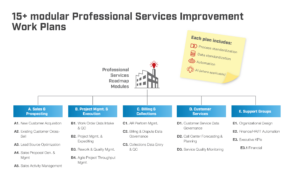
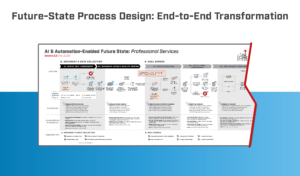
Professional Services Third Standardization Step: To-be process mapping. At this point, draw up the future state of your professional services organization’s processes and client journeys. Counterintuitively, don’t turn to your as-is process map for guidance. Simply map out what you want to get done and then compare that to your First and Second Step outputs.
Professional Services Fourth Standardization Step: KPI defining. List out the key performance indicators or KPIs that will best inform your professional services firm’s executive leadership in its future state.
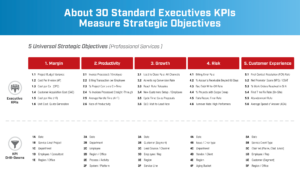
The Lab offers a KPI Handbook especially for Professional Services, with more than 250 essential KPIs listed and defined. It includes metrics for project management, prospecting/sales, billing, and more, all broken out by cost, productivity, revenue impact, organizational scope, volume, quality, and service.
The Lab even offers a catalog of “vital few” Executive KPIs for professional services, which you can download here.
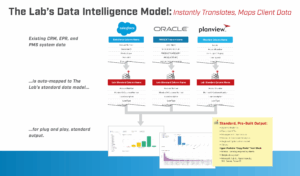
Professional Services Fifth Standardization Step: Data tracking. The fifth step of standardizing your professional services firm is to trace each data element to its source. You will need to parse out its components, and track them to every platform and repository in your professional services firm, including PSA, ERP, CRM, and other core and ancillary systems.
Professional Services Sixth Standardization Step: Data standardizing. Use the data from the Fifth Step to complete this Sixth Step, which entails cleaning it up and mapping it to the Standard Data Model from The Lab. Again, The Lab has templates to make this step go quickly.
Executive Priorities
Four Guidelines for Maximum Transformation Value
As a C-suite executive at your professional services firm, you want to reap all the strategic transformational benefits from your standardization initiative. That means following these best-practice guidelines:
1. Prioritize standardization, enterprise-wide. Organizations require focused priorities; establish standardization as one of your top three strategic initiatives and communicate this priority enterprise-wide.
2. Share wins. Made an automation bot? Create a short video of it in action. Then post that video on the company intranet. Share wins in town halls, news letters, and emails from the C-suite.
3. Standardize process-by-process, and not business-by-business. Don’t be impeded by artificial barriers. Follow the process wherever it leads, regardless or organizational boundaries. Maximum flexibility will yield maximum benefit.
4. Assign “Process Champions.” These are your process champions: respected peers and leaders to guide the initiative to new heights.
Getting Started
Partnership Options and Next Steps
The Lab provides numerous different engagement modalities to meet the varying needs of professional services firms; they include process mapping as a service, data standardization, and templatized solutions covering process improvement, plus knowledge-work automation, analytics, and agentic AI. Our patented methodology improves existing capability at all tiers, while focusing on the standardization of data and processes to speed the implementation of agentic AI and automation.
Are you ready to standardize your professional services business? To schedule your screen-share demo, simply dial (201) 526-1200 or email info@thelabconsulting.com today.