













A How-To Guide for Automating Your Supply Chain Business
Onboard “digital workers” to handle half—or more—of knowledge-work tasks in under a year.
As a supply-chain business executive, technology lead, or member of an internal improvement team, you’re more aware of automation than most people, in most industries. Pick-and-pack warehouse bots have been all the rage for a while now.
But that barely skims the surface—and the potential benefits to your supply chain operation. Consider all the technologies that are floating around these days:
- GPT or generative pre-trained transformer
- LLM or large language models
- RPA or robotic process automation
- Agentic AI—with the AI of course being “artificial intelligence”
- Others
A clear breakdown of AI, RPA, LLM, IDP, and API.
Understanding Automation Tools for Supply Chain
What are these technologies, and which ones deliver the most value for supply chain operations? The Lab is technology-agnostic and does not sell software, making our evaluation of automation options vendor-neutral and objective.
This article covers where and how automation applies to supply chain knowledge work, how digital workers (a.k.a. bots) can handle half or more organizational processes, and a realistic path to getting there in six to twelve months, regardless of supply chain model (lean, push, pull/just-in-time, e-supply, or global).
AI vs. digital workforce in supply chain ops: What is the difference?
The distinction between “digital worker” and “AI” in supply-chain operations is less clear-cut than it might seem. The term “digital worker” is an umbrella term that includes AI, agentic AI, robotic process automation (RPA) and others. Definitions vary across supply chain businesses, and the lines blur further outside the industry.
For this article, terminology is less important than application. The focus here is on what today’s business-process automation tools can do for supply chain operations and not a comparison of platform features.
What do all these acronyms—such as LLM, IDP, API, and RPA—mean in supply chain businesses?
Agentic AI is a tool that can take action (i.e., have “agency”), meaning it can coordinate multiple automation tools simultaneously. These other tools (and acronyms) it works with include:
· Robotic Process Automation (RPA)
refers to software bots which perform actual actions, using existing core and ancillary supply chain systems (such as ERP, CRM, WMS, TMS, SCP, SRM, and others). RPA bots can receive their “marching orders” from agentic AI, upstream.
· Large Language Models (LLMs)
represent the layer in the stack which can comprehend your input in English, whether it’s typed or spoken. It can then hash out the next discrete steps, based on your request.
· Intelligent Data Processing (IDP)
is a technology for extracting information from documents—without even being trained to know their formats in advance, which is a pretty impressive feat. So, it can pull the correct info from, say, a bill of lading, regardless of the carrier.
· Application Programming Interface (API)
is a software protocol by which one platform can “speak the same language” as another, kind of like a universal translator. This is how, for example, you might be able to link your transportation management system or TMS to your supply chain planning or SCP platform. The possibilities are practically limitless.
These tools can be combined to automate a wide range of activities across your supply chain businesses, whether you work in tech and electronics, e-commerce, automotive, food & beverage, consumer goods, pharma, fashion, manufacturing, or any other sector. For the purposes of this article, these technologies are referred to collectively as “digital workers.”
The key word in “digital worker” is “worker.” Like human workers, digital workers can plan, review, and perform tasks. The more tasks they handle automatically, the greater the scalable capacity for your supply chain business.
There is an element of synergy here. More digital workers equate to more than the sum of their parts. Once onboarded and assigned their jobs, they can provide a substantial labor lift to your supply chain business, with less and less human intervention required vs. just a few years ago.
Affordable tools that work with your existing systems.
The Cost and Compatibility of Automation Tools
You may be pleasantly surprised to learn that the pricing for many automation tools is quite modest. License fees are typically nominal. Many apps provide as-needed pricing (pay as you go), with minimal subscription pricing for worker “seats.” The days of huge onboarding fees are largely legacies.
It gets better. You don’t even need to change your existing platforms, which can include:
- ERP (enterprise resource planning), e.g., NetSuite, Oracle, SAP
- WMS (warehouse management system), e.g., HighJump, Manhattan Associates
- SCP (supply chain planning), e.g., SAP IBP, Kinaxis
- TMS (transportation management system), e.g., Blue Yonder
- SRM (supplier relationship management)
With today’s automation and AI tools, digital workers can be layered atop your existing platforms without replacing them. Some of these tools may already be available to you; for example, Power Automate is bundled in with your Microsoft e365 license; you simply need to switch it on.
Standardize first, then automate. Three steps to get ready.
How to Prepare Your Supply Chain for Automation
We can safely assume that if you’re reading this article, not only do you want to accelerate your supply-chain automation transformation, but you also want to do it as quickly and smoothly as possible.
Before we dive into the three prep steps, it’s important to note that standardization is the number one prerequisite. You can’t have your supply chain knowledge residing solely in the heads of your employees. Outdated training manuals and SOPs won’t suffice, either—although they’re a step in the right direction.
This begins with standardizing tribal knowledge, which entails gathering, organizing, analyzing, and structuring it for automation. The three steps below outline how to accomplish that.
The three steps are detailed below:
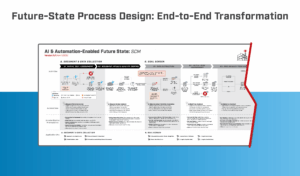
Supply Chain Automation Step 1: Create a to-be process map
This first step is defining what you need your digital workforce to accomplish, not how you will get there. Setting aside the current state at this stage keeps the focus on the future-state operation.
Map out your to-be processes, capturing each automation, KPI analytics tool, and standardization requirement. This should include:
1. All supply chain process steps and workflows, encompassing the six pillars of the SCOR model
2. Future state implemented supply chain automation, including:
- Artificial Intelligence
- Robotic Process Automation
- Expanded functionality of supply chain systems
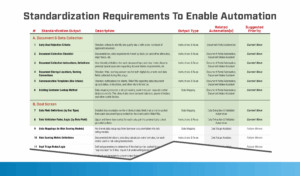
3. Requirements for supply chain standardization, including:
- Quality of supply chain data intake
- Associated data formats and structure
- Manual review and human intervention
4. Improved analytical capacity, including:
- Supply chain metrics such as KPIs and KRIs
- Targets and thresholds
- Standardized actions and insights for supply chain operations
Many supply chain executives and teams find this step difficult because they instinctively compare to-be processes to as-is processes. At this point, that comparison is counterproductive.
The current state is addressed in Step 2. For the time being, let’s focus on remaining entirely on the desired future state of the supply chain operation.
The Lab has templatized the baseline future state for your supply chain operation, harnessing the more than 30 years of client engagement IP and best practices residing in our Knowledge Base.
Supply Chain Automation Step 2: Compare future and current states
A gap analysis between the future state from Step 1 and the current state of supply chain automation is the objective here. The goal is to identify which workflows, activities, tasks, and tools require updating or addition to reach the to-be state.
At this stage simply document the gaps without attempting to resolve them. Examples include modifying a data format for automation compatibility or defining a process checklist for the automation to reference.
The as-is processes you’ll want to compare and contrast against the goals listed in your to-be state:
- Quality of supply chain data intake
- Structure and formatting of supply chain data
- Your extant supply chain automation capabilities
- Requirements for supply chain automation
- Workflows design, such as detecting and handling exceptions
- Capabilities for supply chain performance management
Supply Chain Automation Step 3: Prioritize for benefit
At this point, the gap list from Step 2 needs to be prioritized. This means evaluating not just the impact an automation has at the specific process level, but also its upstream and downstream effects on the broader supply chain operation.
Prioritized in this way, the list becomes a sequenced action plan for implementing future-state supply chain automations with your digital workers assigned accordingly
While you will have done a decent amount of internal work to create your list of action items for automation, there are external resources available, too, with proven automations for supply chain businesses easily accessible.
The Lab’s Knowledge Base contains more than 100 industry-tested use cases for Supply Chain Distributors & Manufacturers, with the Top 40 readily available in our popular Automation & AI Use Case Catalog, so you can start automating ASAP.
The Lab can help you to implement, roll out, and grow your supply chain automation initiative, with:
a) Automation use-case catalogs, helpful for prioritizing
b) Supply-chain-specific development frameworks for code that can be rapidly scaled
c) KPI dashboards to measure and monitor supply chain automation performance
d) Templatized requirements documentation
e) Standards and tools geared toward project management
f) Process improvement guidelines
g) Sequenced maturity models to aid in supply chain capability enhancement
h) Training courses which we can recommend to your internal resources
The automations identified through the to-be-process-mapping, combined with those from The Lab’s catalogs, shorten the path to a fully automated supply chain operation. End-to-end implementation of digital workers is where the most significant enterprise benefit is realized.
Which Supply Chain Systems Can Be Automated?
Vendor-agnostic, platform-agnostic, and ready to work.
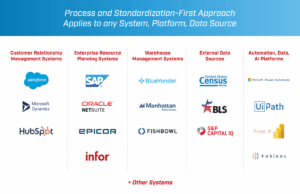
Supply chain business relies on a number of core and ancillary systems, from ERP and WMS to supplier relationship management systems to everyday workhorses like Excel and Outlook.
All of these systems can be automated. The specific systems in use, and how they are interconnected across supply chain workflows, are not limiting factors. Digital workers are truly platform- and vendor-agnostic.
Today’s bots can routinely perform tasks that you may have considered beyond the possibility of automation, regardless of how platforms are configured.
Check out, for example, these three demo videos, all available on The Lab’s YouTube channel, showing actual client-anonymized automation at work for distribution, manufacturing, and supply chain operations:
- Distribution & Manufacturing: Quote-to-Opportunity Conversion AI+ RPA Automation for ERP + CRM 4.5-minute video
- Vendor Invoice Processing AI+ Automation for Accounts Payable Robotic Process Automation Demo 3-minute video
- Supply Chain & Manufacturing Operations: AI & Automation for Daily OEM Reconciliations Reporting 2.5-minute video
Is there a best practice methodology for increasing automation at supply chain businesses?
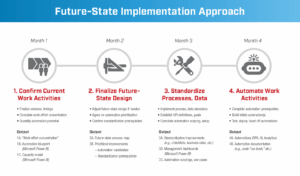
The Lab has developed and refined this roadmap over decades of client engagements. Following it, supply chain operations can implement digital workers in less than a year.
The four-step process is outlined below, including a best practice agile development process for Step 4, which covers how to automate supply chain work activities in detail.
Are there common traps to avoid when automating supply chain operations?
Yes, there are. But you can avoid them, if you know what they are. Being aware of these traps in advance makes them easier to avoid:
Traps, Bottlenecks, and Sponsorship Best Practices
What slows automation down, and how to prevent it.
Supply chain businesses are driven by metrics, KPIs, and SLAs. When quantifying the benefits for automation, you don’t want to fall into the common trap of merely looking at the number of hours saved for each incremental activity you automate.
Automating discrete tasks, you’re actually empowering the entire business to scale up its capacity, end-to-end.
Obsessing over minuscule time saving of things like keystrokes recouped. Instead, zoom out to properly gauge the value of your entire complement of digital workers.
Common Trap 2: Measuring piecemeal vs. comprehensive benefits
Supply chain managers will often create “requirements” along the lines of “Each supply chain bot must save at least 1,000 hours of manual labor a year.”
A digital worker may save fewer than 1,000 hours per year at a specific task, but that measure does not account for the downstream benefits, which can often be many multiples of what’s saved at the actual point of supply chain automation.
A more useful question is: “What portion of the entire business process is being automated?” The more this is automated upstream, the more you can automate downstream. Automation frees you to introduce even more automation, in a truly virtuous cycle for supply chain businesses.
The Six-Month Onboarding Roadmap
From planning to live bots, your six-month implementation guide.
This is the roadmap we’d mentioned earlier. For each step below, we’ll list the activities and deliverables.
Supply Chain Automation Step 1: Document as-is workflows
Activities:
- Calculate workflow volume and sequence timeframes
- Determine the work-effort concentration of each
- Add up the full potential of the supply chain automation
Deliverables:
- Work effort concentration for each of the above
- Blueprint for supply chain automation (e.g., in Microsoft Power BI)
- Documented supply chain capacity model (again, using a tool such as Power BI)
Supply Chain Automation Step 2: Sign off on to-be design
Activities:
- Update the to-be design
- Gain consensus on automation priorities
- List out all requirements for standardization
Deliverables:
- To-be state supply chain process map
- List of improvements, in priority order
Supply Chain Automation Step 3: Update data and processes for standardization
Activities:
- Create standards for each supply chain process and data set
- Define KPIs and objectives
- Scope the automation and its setup
Deliverables:
- Lists of supply chain standardization improvements in the form of business rules, to-do lists, check-off items, etc.
- KPI dashboards for management (use a BI [business intelligence] platform)
- Actual written automation scope and discrete use cases for supply chain operations
Supply Chain Automation Step 4: Bring automation to actual workflows
Activities:
- Finish listing all automation requirements
- Create pilot automation bots
- User-test these bots; then deploy
Deliverables:
- Actual supply chain automation, featuring RPA/agentic AI/advanced data analytics
- Bot code run-book to document deployed automations
What is the best practice agile development process for supply chain automation?
As referenced earlier, here is the best practice agile development process for Step 4, covering how to create actual supply chain automations.
The Lab is an implementation firm. Our role is to help supply chain organizations build automations that deliver measurable enterprise value.
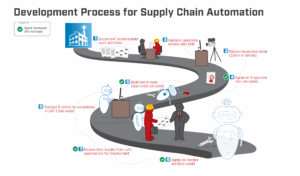
Agile Automation Development for Supply Chain Operations
What are the top 3 roadblocks or bottlenecks for supply chain automation?
There are three common issues that can impede supply chain automation progress:
Supply Chain Automation Bottleneck 1: False-precision requirements
Don’t focus on discrete augmentation of manual sit-at-the-computer activities. Remember: The real benefits of digital workers reside downstream; think of them as work-force multipliers.
Similarly, there are benefits beyond the cost savings which will be discussed later in this article.
Supply Chain Automation Bottleneck 2: Excess security layers
Unlike human workers, bots operate exclusively within their assigned scope. Meaning, permissions can be scoped accordingly, and existing security safeguards are typically adequate without requiring new ones to be created.
Supply Chain Automation Bottleneck 3: Too many reviews and approvals
Additional stage gates add complexity without adding value and slow the initiative in the process. Keep it simple by asking and answering each of these questions:
1. Will it automate manual activities?
2. Will it open the doors for further downstream automation?
3. Can it be developed in less than 6 months?
In this review-light environment, any two questions answered as “Yes” equates to your go-ahead to move forward.
What are the best practices for supply chain automation executive sponsorship?
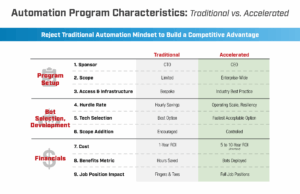
In order to maximize the benefits of automation in your supply chain business, you need to really pay attention to executive sponsorship; an initiative like this will live or die from the top down. Don’t characterize it as some kind of IT project. Instead, show the enterprise that you’re committed to increasing scalable capacity by expanding your digital workforce. Here’s how:
1. Select your automations in quick waves
- Automation waves should consist of ten or more bots
- Review selected bots for feasibility rapidly
- Commit to the selected bots with frontline SMEs
- Lather/rinse/repeat the above steps
2. Dedicate resources to the job
- Assign individual points of contact from:
- IT shop
- Frontline SMEs
- Project managers
- Stick to one-day turnaround
3. Head off delays
- Keep UAT to one week
- Limit hypercare to one week
- Create and deploy system-access requests
- Avoid the tendency to over-document the supply chain automation
4. Display proactive sponsorship throughout
- Focus on strategic supply chain value vs. mere hourly savings
- Establish deployment objectives
- Incentivize bot deployment
- Shut down any scope creep
- Discourage last-minute tweaks
The Benefits of Supply Chain Automation
What your supply chain operation stands to gain from automation.
Whether you’re looking to increase resilience, innovate last-mile delivery, or overcome persistent labor challenges, you’ll find a broad range of valuable benefits that come with automating your supply chain business, which extend far beyond the mere cost savings:
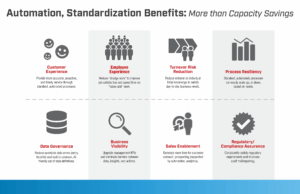
Supply Chain Benefit from Automation Number 1: Improve elasticity among processes. Digital workers decouple operational capacity from headcount. They can be scaled to match demand, eliminating the need to rely on hiring or layoffs to accommodate workload changes.
Supply Chain Benefit from Automation Number 2: Elevate CX. It doesn’t matter if your supply chain customers are in retail, manufacturing, automotive, fashion, pharmaceuticals, or any other vertical; when you standardize and automate your supply-chain business’ activities and processes, your customers will enjoy more consistent, accurate, and proactive customer experience or CX.
Supply Chain Benefit from Automation Number 3: Decrease your reliance on tribal knowledge. Supply chain automation institutionalizes your workflows, outside of individual rules of thumb or other bits of tribal knowledge. That reduces your risk from turnover, so daily workflows can continue unimpeded.
How much is turnover costing your supply chain operation?
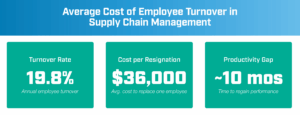
The cost to replace a single employee, salaried at $80k, costs about $240k in actual value. Here’s how we calculated that number: Typical turnover rates hover just below 20 percent. Add in the per-resignation cost of about $36k. Then add in the gap in productivity, typically 10 months in duration. So, the cost of turnover for that single $80k worker is anywhere from 150 percent to 250 percent of their salary. Which of the above factors apply to digital workers? You guessed right: None.
Supply Chain Benefit from Automation Number 4: Reduce data errors. So many supply chain data errors emanate from the transfer, or even original entry, of data. Your data will be better governed once you install a centralized, AI-ready repository of data definitions.
What does bad data cost your supply chain business?
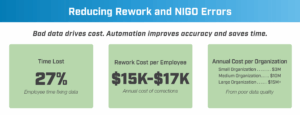
The Lab coined the term “NIGO,” or “not in good order” data which costs anywhere from 24 to 36 percent of lost time, just to repair the data. This amounts to $14k to $18k, per employee, per year, just to fix mistakes. Remediating subpar data costs the typical supply chain business millions each year.
Supply Chain Benefit from Automation Number 5: Elevate your employees’ experience. No one on your team enjoys performing repetitive tasks like copying and pasting data from one system into another. When you automate these activities, you free up your employees for more satisfying tasks that add value to customers and the enterprise.
Consider as just one example: Processing vendor invoices for Accounts Payable. Watch this three-minute video from The Lab, showing how we “built a bot for that.”
Supply Chain Benefit from Automation Number 6: Increase KPI effectiveness. Automating your supply chain business comes with the benefit of more granular KPIs for both executives and management. This increases visibility, enhances decision-making, and boosts performance of vital metrics. You’ll tear down the walls that currently stand between your data… and data-empowered insights and action.
Supply Chain Benefit from Automation Number 7: Boost sales. Few benefits of supply chain automation are as compelling as this one. Imagine your sales team’s performance amplified with digital workers and data analytics: They’ll be more effective, with more time for upsell and prospecting alike.
Supply Chain Benefit from Automation Number 8: Enhance compliance. Whether it’s proper labeling of packages containing rechargeable batteries, or adhering to ever-evolving global sustainability regulations, you’ll fortify your audit trail and reporting when you automate your supply chain operational processes and activities.
Sustaining and Scaling Your Automation Program
Long-term support, performance tracking, and continued growth.
Once the engagement with The Lab concludes, your supply chain operation will be equipped to continue automating independently.
This starts early in the process with The Lab working alongside your team during the development and onboarding of the digital workers, so there’s a great deal of knowledge transfer. Still, we offer executive sponsors and their supply chain organizations a variety of ongoing support of installed automations. These include:
- Supply chain bot maintenance. Prevent issues before they occur. When large-scale system changes loom on the horizon, The Lab can assess the impact on different activities and the bots that perform them. We can even help to re-train your digital workforce. Schedule maintenance and performance audits are offered as well, reflecting the fact that digital workers typically require approximately one hour of preventative maintenance per month.
- As-needed repair of supply chain bots. The Lab provides break-fix services on an as-needed basis, with same-day services available. This service is a pay-as-you-go option, with no retainer or commitment.
- Training for the support of supply chain bots. The Lab has curated the best available training materials (many of which are free) to elevate your team’s skill-set in minimal time. This approach is designed to build long-term self-sufficiency, as your developers transition to managing and supporting automation independently.
- Support for core technology transfers. On the rare occasion that you need to swap out a core supply-chain system, The Lab can help to re-train your digital workers for the new regime. The Lab can assess the impact, provide a quote, and proceed accordingly.
How does supply chain automation improve performance and KPIs?
Data is the foundation for achieving the supply chain automation benefits outlined in this article.
That data already exists across your systems and data lakes/repositories. The next step is optimizing it for digital workers, which involves standardizing it with a proper glossary, taxonomy, and tagging. Once in place, human and bot performance can be measured and monitored with a high degree of precision:
- See their performance in real time or near real time.
- Manage performance based on actual, actionable data, no ambiguity.
- Reduce risk by spotting patterns that could raise it.
- Automate even more activities than you’d previously considered possible.
Be sure to check out The Lab’s deep-dive article concerning Data Intelligence, Analytics & Executive KPIs. With The Lab’s Knowledge Base templates, you can transform your supply chain business often in just 6 months.
Accelerate the automation of your supply chain business with The Lab
For over three decades, The Lab has worked with executive sponsors at supply chain businesses to accelerate their automation initiatives as part of larger-scale transformations which yield quantifiable business value.
Our patented Knowledge Work Transformation™ methodology, industry-tested solutions and services, and unique Knowledge Base of templatized client-engagement IP, can help to automate the knowledge work in your supply chain operation in just six to 12 months.
Are you ready to automate your lean, push, pull, or e-supply chain business? Learn more: Book your screen-sharing demo with the friendly experts from The Lab. Simply call (201) 526-1200 or email info@thelabconsulting.com today.